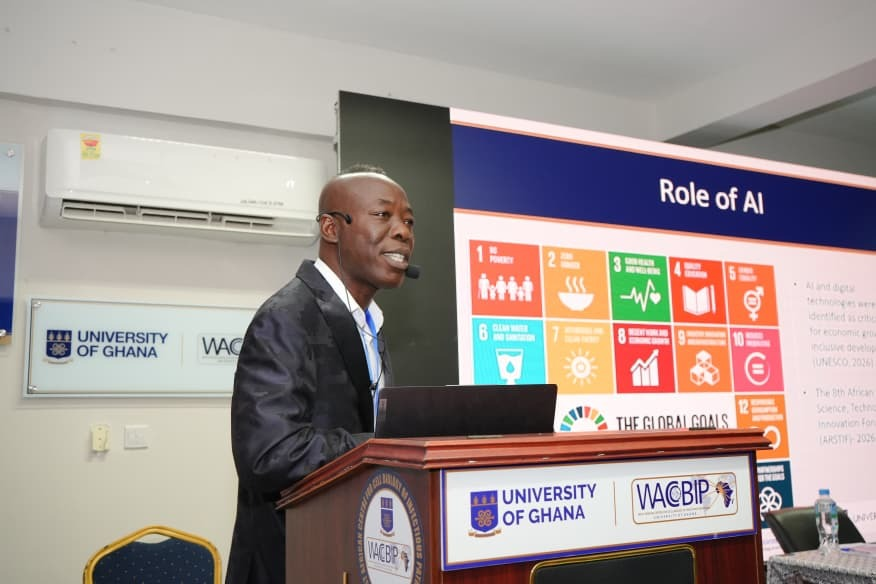
The Professor Leading Africa's AI Revolution
Director of the Institute of Applied Science and Technology (IAST) at the University of Ghana, Prof. Samuel Kojo Kwofie, has issued a call to action for Ghana and Africa to harness the power of untapped data and transform it into equitable AI solutions that address the continent's most pressing societal challenges.
Speaking at the 2026 Day of Scientific Renaissance of Africa, Prof. Kwofie declared that data is the new gold and Africa is sitting on a vast, largely unexploited reserve.
Africa's AI Revolution Gains Momentum
Ghana and Africa at large have a wealth of data that remain unused to create solutions for health, agriculture, climate change, and beyond. Prof. Kwofie emphasized that investing in AI and data science is one of the surest ways to tap into the new gold. Over the past five years, AI investment in Africa has surged from roughly $1.2 billion to an estimated $4.1 billion, according to Prof. Kwofie.
Ghana Takes the Lead
Ghana is not standing on the sidelines. Earlier this year, President John Dramani Mahama officially launched the National Artificial Intelligence Strategy 2025–2035, marking the beginning of what officials describe as the country's AI revolution. The strategy's vision, "GHANA 2035: THE AI-POWERED SOCIETY," envisions a transformed society where AI advances the potential of people, government, businesses, and systems to achieve inclusive social and economic transformation.
Universities Must Lead the Way
Prof. Kwofie challenged universities across Ghana, particularly his own institution, the University of Ghana, to reposition themselves as AI-powered institutions within the next decade. "The University of Ghana and other universities in this country must see themselves as AI-powered in the next 10 years to come," he intimated. "We cannot afford to be spectators in this revolution. Our universities must lead in developing AI-driven solutions that address our unique African challenges."
Frugal Innovation for an Equitable Africa
Prof. Kwofie stressed that equity is not only about advanced technology but also about ensuring innovations remain affordable and accessible. He cited examples of AI-powered mobile ultrasound scans being used by traditional birth attendants in rural communities without state-of-the-art health facilities, and the University of Ghana's open-source ventilator design project, which reflect this commitment to accessible healthcare.
The Clock is Ticking
The next decade will determine whether Africa becomes a producer of AI solutions or remains a consumer of technologies designed elsewhere. Prof. Kwofie reiterated that the work cannot stop at the university gates and that the clock is ticking fast. The Institute of Applied Science and Technology positions itself as a bridge connecting science, technology, industry, and society, and its work spans seven cross-cutting units, including an Artificial Intelligence, Data Science, and Engineering platform that trains youth in AI and translates research outputs into essential products for use in communities.
Source: Joy Online