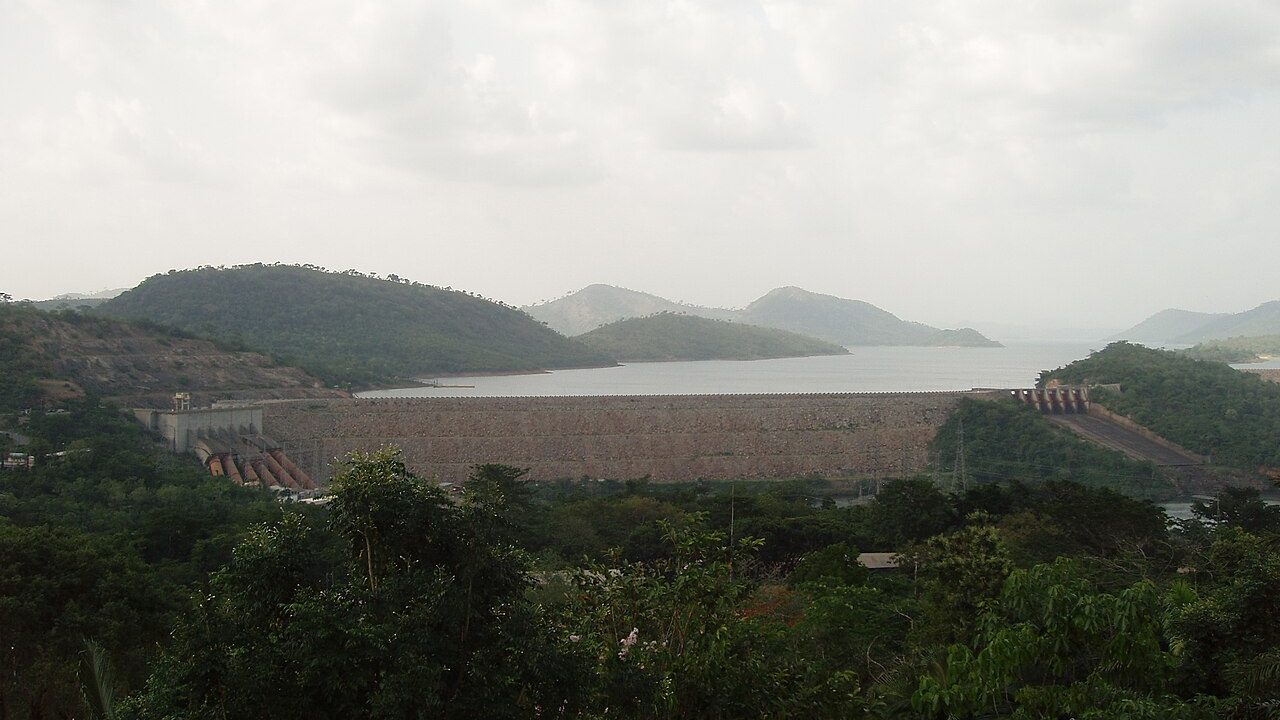
Every time the lights come on in Accra, there is a fair chance the power began its journey at a gorge on the Volta River, about 100 kilometres to the north-east. The Akosombo Dam has shaped Ghana’s economy, its map and the lives of tens of thousands of people for six decades.
An old idea
The idea of damming the Volta for power was discussed in colonial times, and development of the Volta basin was formally proposed in 1949. The problem was money. The project was enormous, and the Gold Coast could not pay for it alone.
Nkrumah’s project
After independence, Kwame Nkrumah adopted the Volta River Project as a centrepiece of his plans to industrialise Ghana. Cheap, plentiful electricity, he argued, would power factories and free the country from dependence on raw exports.
In 1961, Parliament passed the Volta River Development Act, which set up the Volta River Authority to run the scheme.
The builders
In May 1960, the government invited tenders for the dam. In 1961, the Italian consortium Impregilo, which had just finished the Kariba Dam on the Zambezi, won the contract.
Aluminium and VALCO
The dam’s main customer was to be an aluminium smelter at Tema, run by the Volta Aluminium Company, VALCO, and overseen by the American firm Kaiser Aluminum. The smelter’s investment was backed by the Export-Import Bank of the United States. The deal gave Ghana a guaranteed buyer for power; critics later argued the price VALCO paid was far too low.
Lake Volta
When the gates closed, the river backed up to form Lake Volta. It covers 8,502 square kilometres, about 3.6 percent of Ghana’s land area, making it the largest artificial lake in the world by surface area.
The people who moved
The rising water flooded hundreds of villages. Tens of thousands of people were resettled in new towns. The resettlement was complex and in many cases unsuccessful: traditional farming practices disappeared and poverty increased in some communities.
Power output
The dam’s original capacity was 912 megawatts. A retrofit completed in 2006 raised it to 1,020 megawatts. Power from Akosombo is also exported, and it has supplied much of the electricity used in Togo and Benin.
When the lake runs low
Because Akosombo depends on rainfall, poor rainy seasons reduce the lake level and the power it can produce. Low water has been one of the causes of Ghana’s power shortages, pushing the country to add thermal plants and other sources.
A town built for a dam
Akosombo town itself was planned for the project, with housing for workers and engineers on the hills above the river. Nkrumah even commissioned a residence overlooking the dam, designed by the Australian architect Kenneth Scott.
Still the backbone
Sixty years on, Ghana has more power stations than Nkrumah could have imagined. Yet when engineers talk about the grid, they still start with the water level at Akosombo, because so much else depends on it.