

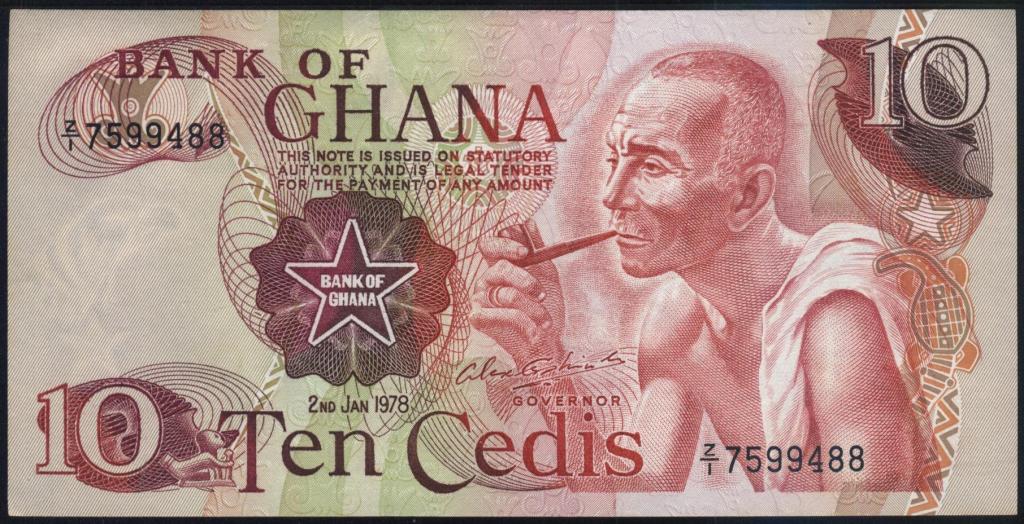
Every Ghanaian who handles money today uses the cedi. But for the first eight years after independence, Ghanaians still counted in pounds, shillings and pence. The change came in July 1965, and it was as much a political statement as an economic one.
From West African pound to Ghanaian pound
Before independence, the Gold Coast used the British West African pound, shared by Britain’s colonies in the region. After independence in 1957, Ghana separated from it and issued its own currency, the Ghanaian pound, used from 1958 to 1965.
The decimal switch
In 1965, Ghana decided to leave the old colonial monetary system and adopt the decimal system, which was simpler to calculate and widely used around the world.
The cedi and the pesewa
In July 1965, Nkrumah’s government introduced cedi notes and pesewa coins to replace the Ghanaian pounds, shillings and pence. One hundred pesewas made one cedi.
The name
The name cedi is widely linked to the Akan word for the cowrie shell, which was once used as money in West Africa. The pesewa, too, has a local origin, and together the names signalled a break with colonial money.
Nkrumah on the notes
The first cedi notes carried Nkrumah’s portrait. After his overthrow in February 1966, the new government moved quickly to remove his image from the currency.
The new cedi
In 1967, the National Liberation Council introduced the “new cedi”, worth 1.2 of the old cedis. At its introduction, it was equal to half a pound sterling.
Inflation
Over the following decades, high inflation steadily eroded the currency’s value. By 2007, the largest note, the 20,000 cedi note, was worth only about US$2, and people carried bundles of cash for everyday purchases.
Redenomination
In 2007, Ghana redenominated the currency, removing four zeros. The new Ghana cedi replaced 10,000 old cedis. It remains the currency today, with notes up to GH¢200.
Money and identity
Currencies carry national symbols. Ghana’s notes have featured independence leaders, landmarks and national emblems, telling a story about how the country sees itself.
A shell and a nation
The cedi’s name reaches back to the cowrie, one of Africa’s oldest currencies. Nkrumah chose it for a modern, decimal money meant to show that Ghana could run its own affairs, a message printed on every note.
,_front.jpg)