
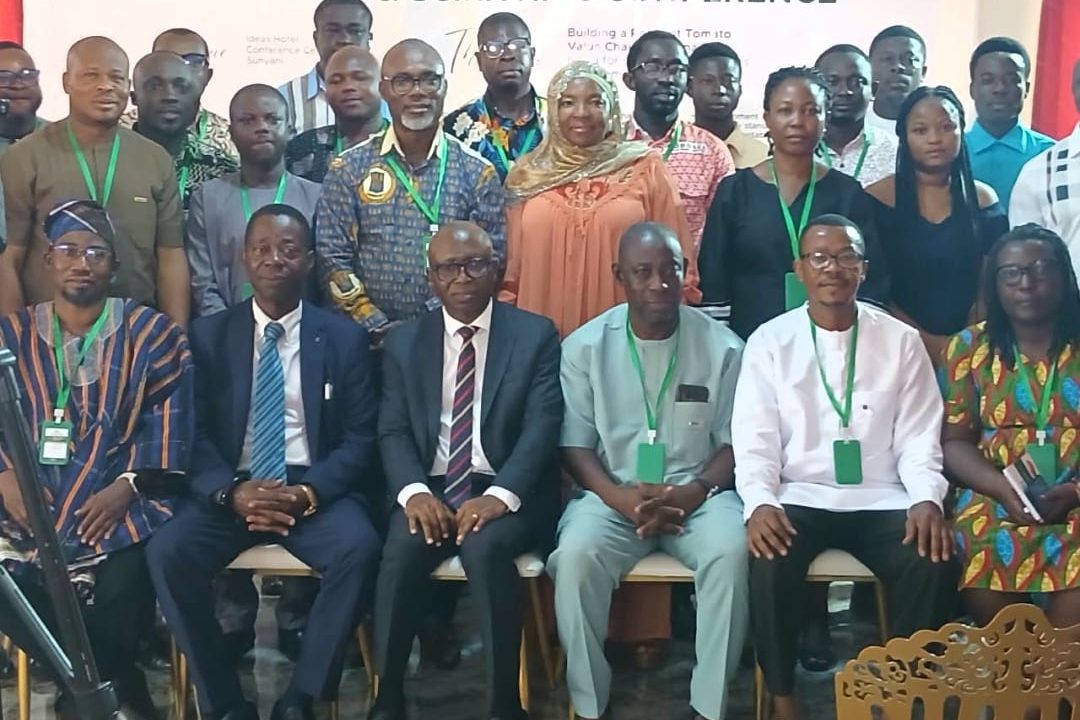
A truck carrying Ghanaian tomato traders was caught in a terrorist attack in Titao, Burkina Faso, on February 14, 2026. The incident has intensified calls for urgent action to address the ongoing crisis in Ghana’s tomato sector. At the 26th Annual General Meeting and Scientific Conference of the Ghana Institute of Horticulturists (GhIH), held from October 1 to 3, 2026, in Sunyani, the Institute’s president, Dr Mohammed Mujitaba Dawuda, urged the government to formally engage horticultural professionals to tackle the sector’s persistent challenges.
Dr Dawuda, who also lectures at the University of Development Studies, said the Institute had long worked to address problems in tomato production and marketing through research, training, and stakeholder engagement. Yet, despite horticulture’s importance to Ghana’s food system, the government has not given the Institute formal recognition or involvement. “Unfortunately, government, as a stakeholder in the horticulture industry, is yet to give us the needed attention and yet to have formal engagement with us as an institute,” he said.
The conference’s theme, “Building a Resilient Tomato Value Chain in Ghana: Need for Stronger Stakeholder Engagement,” reflected the Institute’s focus on finding solutions to issues that include soil fertility, seed and variety selection, root-knot nematodes, pests and diseases, high temperatures, irrigation challenges, and post-harvest losses. Dr Dawuda also pointed to the recurring problem of tomato glut and scarcity as a major obstacle to the sector’s growth.
“The tomato challenge has been common knowledge in Ghana for decades,” Dr Dawuda said. The recent terrorist attack in Burkina Faso involving Ghanaian traders has brought renewed attention to the plight of those working within the sector.
The three-day event gathered researchers, farmers, government representatives, agricultural officers, development partners, and private-sector actors to discuss these challenges. Organisers plan to develop a communique from the conference discussions for presentation to relevant stakeholders.
The special guest, Prof Elvis Asare Bediako, Vice-Chancellor of the University of Energy and Natural Resources, called for stronger collaboration among institutions and actors in the tomato sector. “We need to move beyond talking about collaboration to institutionalising collaboration,” he said.
Prof Bediako explained that the problems facing the sector are interconnected. Disease outbreaks reduce yields, poor-quality planting material undermines production, climate variability affects both productivity and quality, and poor post-harvest handling causes significant losses. Weak market linkages and limited processing capacity add pressure on farmers and the fresh produce market.
He proposed viewing the tomato sector not simply as a value chain but as a value network. This network involves continuous exchange of information, knowledge, technology, finance, risks, and opportunities among farmers, researchers, processors, financiers, government, and other actors. “The strength of the tomato sector depends on the strength of the relationships among its actors,” Prof Bediako said.
The Ghana Institute of Horticulturists has consistently sought practical solutions through research and stakeholder engagement. Its president reiterated the Institute’s dedication to its vision and mission, calling on researchers, farmers, agricultural officers, traders, students, NGOs, and farmer-based organisations to participate actively in discussions.
The conference highlighted the need for government involvement alongside other stakeholders to address long-standing issues in tomato production and marketing. The Institute’s appeal for formal engagement remains unanswered, even as incidents like the Burkina Faso attack underline the sector’s vulnerability.
According to Joy Online.