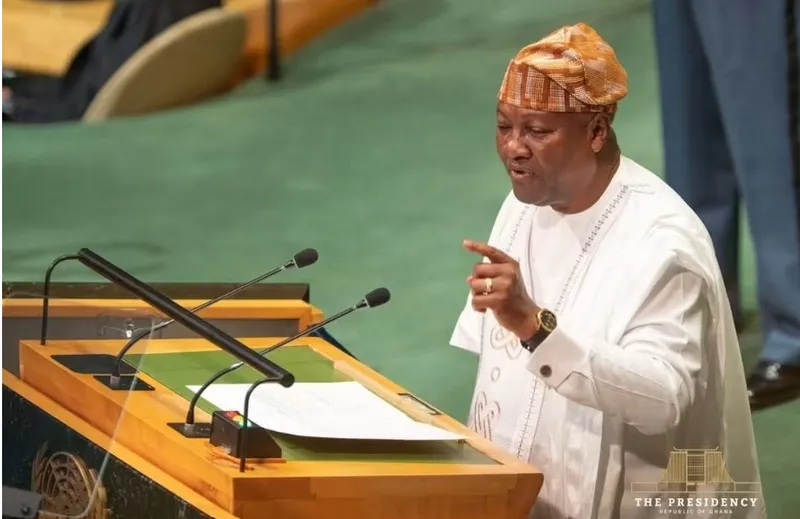
Africa pays eight times more to borrow money than the rest of the world, President John Dramani Mahama said during a speech at the Council on Foreign Relations in New York last week. The continent, rich in oil, lithium, cobalt and other resources, supplies materials essential to the global economy. Yet it faces higher risk premiums and interest rates when seeking capital to develop itself.
Mahama estimated that illicit financial flows drain about $90 billion annually from Africa. Added to that are billions lost in debt servicing and the extra costs attached to African risk profiles. Taken together, he said, more than $240 billion leaves Africa every year through these channels. This outflow far exceeds the development assistance returning to the continent.
The president said these financial pressures contribute to a cycle in which African economies repeatedly face crises. “At what point do we ask whether we are fixing African economies or simply preparing them to survive another round of the same system?” he asked.
Mahama argued that Africa’s debt problems start long before International Monetary Fund programmes intervene. The conversation often focuses on debt itself, but he said it should include the structural issues that cause the continent to be treated as a greater financial risk despite its resources.
Ghana exemplifies these contradictions. The country exports gold, cocoa, oil and other commodities that bring in foreign exchange. Yet the local currency, the cedi, remains highly vulnerable to pressure from the US dollar. When the cedi weakens, businesses pay more for imported machinery and raw materials. Eventually, ordinary Ghanaians feel the impact, even if they never hold a dollar themselves.
Recent data from the IMF shows Ghana’s international reserves reached $11.9 billion by the end of 2025, helped by strong gold exports. The cedi also strengthened significantly. Mahama questioned why a country producing so much gold, cocoa and oil still struggles to keep more of the value generated by those resources within its borders.
He said Ghana intends to process 50 percent of its cocoa locally, shifting from simply exporting raw commodities to adding value within the country. This plan comes amid the realities facing farmers whose livelihoods depend heavily on cocoa prices, disease risks and climate change. Mahama suggested diversification should become part of the agricultural conversation, with farmers able to combine cocoa with food crops, commercially useful trees and agroforestry systems to provide multiple income streams.
The president tied these vulnerabilities to wider economic challenges. A country reliant on a few raw commodities and dependent on a currency it does not print remains exposed. Africa, paying premium borrowing costs controlled outside the continent, shares similar risks.
Mahama said Ghana’s relationship with the IMF deserves deeper scrutiny. The IMF has helped stabilise the Ghanaian economy, including rebuilding reserves and managing debt. But he questioned whether these interventions address the root causes that push Ghana into crisis repeatedly. “Stabilising an economy is one thing. Making sure it does not keep falling into the same crisis is another.”
He warned against normalising IMF programmes as part of an economic cycle of crisis, recovery and relapse. Instead, he called for reforms that produce more locally what Ghana currently imports, build stronger domestic sources of capital, reduce dependence on expensive foreign borrowing, and approach institutions like the IMF from a position of strength rather than desperation.
Mahama stressed that Ghana cannot afford another generation spent simply recovering from crises. “The real measure of our economic progress should not be how quickly we recover every time the system breaks. It should be how difficult we become to break in the first place.”
According to 3News.