

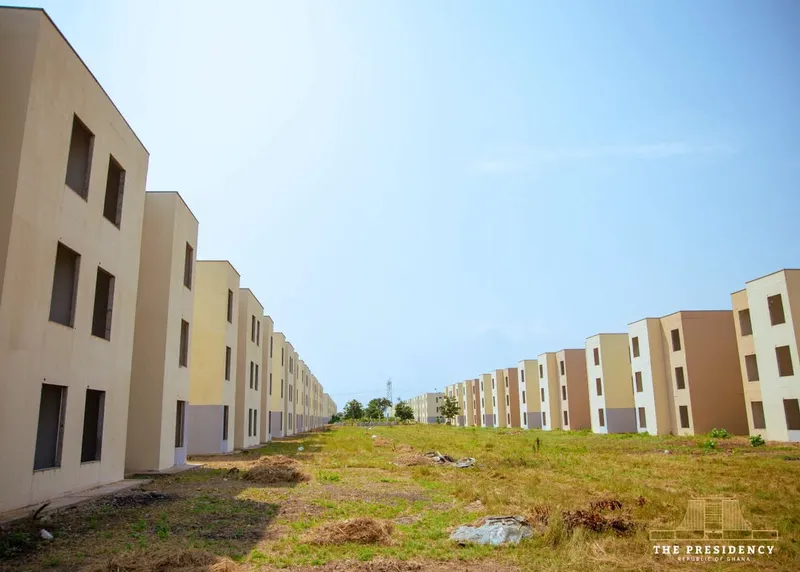
Ghana’s government launched a National Mortgage Scheme on World Habitat Day 2026, aiming to lower the barriers that keep millions from owning homes. The new initiative offers mortgage financing at an interest rate of about 8.4 percent per annum with repayment terms stretching up to twenty years. It targets Ghanaians excluded from traditional mortgage markets, a group that data shows forms the majority of the population.
Only around 5 percent of Ghanaians can afford housing without support, according to figures from the Ghana Statistical Service. About 60 percent require state help, while 30 percent remain unable to access housing even with government subsidies. The Ministry of Works, Housing and Water Resources (MWHWR) and the Ministry of Local Government, Chieftaincy and Religious Affairs (MLGCRA) emphasised these statistics while unveiling the mortgage scheme as part of Ghana’s observance of World Habitat Day under the theme “Adequate Housing for All.”
The government’s push comes amid rising land prices, construction costs, and limited affordable financing options. It has partnered with the National Housing Fund and Republic Bank to offer this new mortgage facility. Officials said the programme will provide “more Ghanaians, particularly those excluded from traditional mortgage markets the opportunity to own decent homes.”
Beyond the mortgage scheme, government efforts include decentralising housing development and expanding affordable housing outside major urban centres. The Greenville District Housing Programme and the National Rental Assistance Scheme aim to improve housing choice nationwide.
Ghana’s housing policies also extend to vulnerable groups. Ground-floor units in new developments are reserved for Persons with Disabilities (PWDs), with agencies directed to consult disability groups and integrate accessibility into housing design and planning.
The government recently launched two major policy frameworks to tackle urban housing challenges. In July 2026, the Ministry of Local Government, Chieftaincy and Religious Affairs introduced the National Urban Policy and Implementation Plan (2026-2035) alongside the National Slum Upgrading and Prevention Strategy and Implementation Plan (2026-2035).
These policies aim to increase affordable and social housing through various measures: expanding low-income rental housing, streamlining approval processes, and encouraging private sector involvement. They also seek to regularise land tenure, provide public land for low-cost housing, and support innovative housing finance and resilient building technologies.
Improving informal settlements is central to the slum upgrading strategy. Efforts include land pooling, land readjustment schemes, and expanding rental housing opportunities. The government made clear that preventing slum growth requires making adequate housing accessible and affordable.
The housing theme for World Habitat Day 2026 stresses that housing is more than shelter. It provides security and a foundation for communities to thrive. Officials say that Ghana’s housing strategy incorporates this view by promoting integrated developments that combine housing with essential infrastructure such as potable water, sanitation, roads, electricity, drainage, and public spaces.
The government’s ongoing review of the National Housing Policy includes provisions to strengthen inclusive housing delivery. This aims to ensure that future interventions meet the needs of all citizens and support equitable communities.
The National Mortgage Scheme and urban policy reforms indicate Ghana’s direction on housing for the next decade. The government is leveraging partnerships with private developers, offering land and infrastructure access, and working to expand credible off-takers.
Ghana’s housing deficit remains large. Yet these steps reflect an effort to bring millions closer to homeownership and decent accommodation.
According to 3News.


