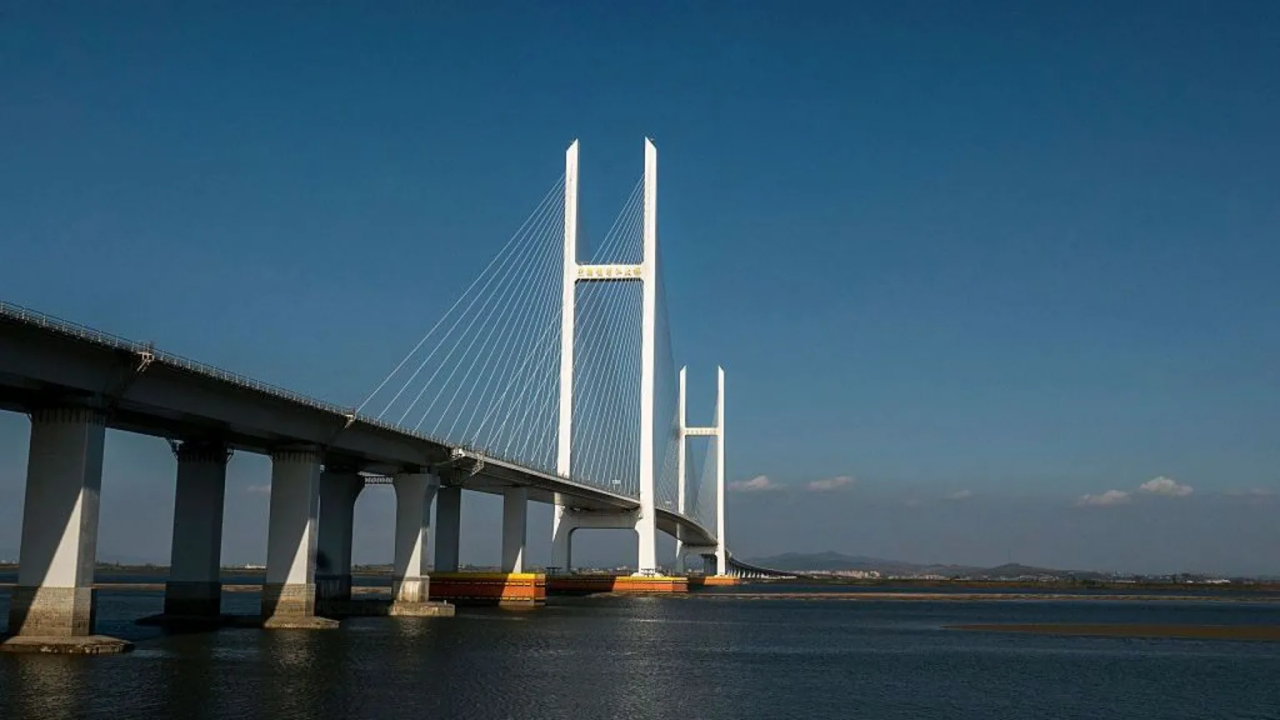
China and North Korea have opened a 3km road bridge over the Yalu River, ending a delay that stretched for 12 years. The New Yalu River Bridge links Dandong in China to Sinuiju in North Korea, and is expected to become the main land route for trade between the two neighbours.
The bridge was originally scheduled to open in 2014 but stalled after North Korea stopped building connecting roads and customs facilities. Relations between Beijing and Pyongyang cooled at the time, in part due to tensions over North Korea’s nuclear weapons programme.
Chinese state media reported the bridge’s opening this week. Chinese Foreign Ministry spokesperson Mao Ning called it an “important facility for connectivity,” saying it will “further facilitate trade and people-to-people exchanges.” Last year, trade between the two countries recovered to $2.7bn, returning to pre-pandemic levels mainly driven by Chinese exports to North Korea.
The New Yalu River Bridge is an alternative to the older Sino-Korean Friendship Bridge built between 1937 and 1943 during Japan’s occupation of the region. The older bridge has long been the main crossing point but is limited in capacity.
Despite the bridge’s launch, a sharp increase in trade remains unlikely. Kang Jun-young, a professor of Chinese studies at Hankuk University of Foreign Studies, told the BBC that UN sanctions on North Korea remain in effect. He added that Pyongyang is cautious about allowing a flood of Chinese imports that could increase China’s influence over its domestic market. “China is well aware of these concerns, so trade is more likely to grow gradually,” Kang said.
The relationship between Beijing and Pyongyang has its tensions. They have a mutual defence treaty, China’s only such treaty with any country. The alliance is often described as “close as lips and teeth,” a phrase attributed to Mao Zedong.
However, ties cooled in the 2010s amid North Korea’s nuclear tests. Kim Jong Un’s 2017 nuclear test and subsequent missile launches heightened US military cooperation with South Korea and Japan. China’s stance has shifted recently, with less public criticism of North Korea’s nuclear programme. Edward Howell, a University of Oxford lecturer, told the BBC that China, which once called for denuclearisation, is now largely silent on the issue.
Observers link the change partly to North Korea’s growing closeness with Russia following the Ukraine war. At least 2,300 North Korean soldiers have reportedly died fighting for Russia in Ukraine. Russia supplies North Korea with oil despite UN sanctions. In 2024, Russia was estimated to have sent over a billion barrels of oil to North Korea in exchange for weapons and troops.
Last month, North Korea and Russia opened their first road bridge, allowing up to 300 vehicles and more than 2,000 people to cross daily, according to Russian state media.
Beijing appears to be trying to reassert influence over Pyongyang. Air China resumed direct flights between Beijing and Pyongyang in March after a six-year pandemic hiatus. Passenger train services reopened the same month. Chinese President Xi Jinping made his first state visit of 2024 to Pyongyang in June, meeting Kim Jong Un.
Leif-Eric Easley, professor at Ewha University in Seoul, told the BBC the bridge’s opening shows improving bilateral relations and that Xi’s visit was “more than symbolic.” Easley added that the long delay, including North Korea’s pandemic self-isolation and domestic crackdowns, demonstrates how difficult a partner Pyongyang remains for Beijing.
According to Joy Online.