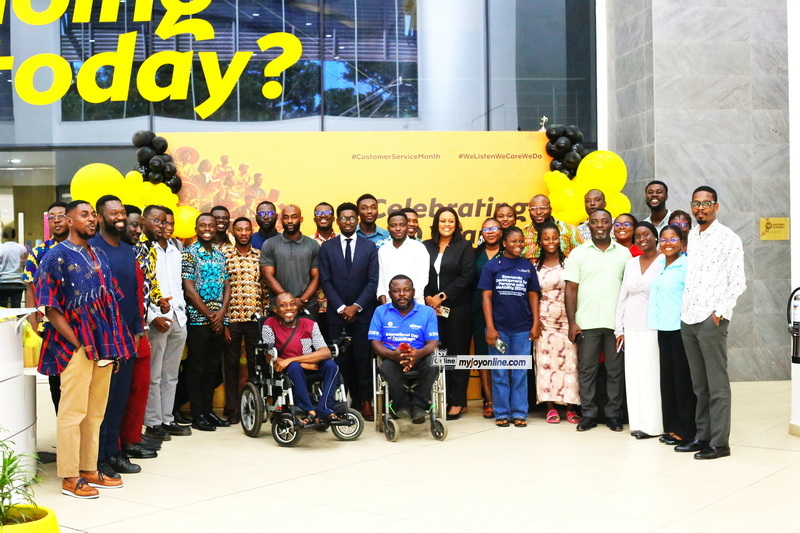
More than 100 civil society leaders gathered at MTN Ghana’s Head Office in Accra on Thursday for a one-day Artificial Intelligence workshop aimed at expanding their understanding of AI and its societal implications. The event is part of MTN’s annual programme to develop human resources across Ghana.
Efua Falconer, Acting Senior Manager for Corporate Communications at MTN Ghana, opened the workshop by stressing that AI is transforming every aspect of life. “AI, transformation. It is indeed transforming everything around us. And we cannot leave you behind,” she said.
Falconer noted that MTN has engaged a wide range of stakeholders—including schools, media, regulators, and communities—in conversations about AI. “Today is your turn,” she told the participants, urging them to engage fully in the practical sessions. “Please make sure you ask questions; there’s a lot of practical work. Engage, take your laptop and just follow along.”
She explained that while governments regulate and companies like MTN build the infrastructure powering AI, civil society acts as the voice for vulnerable groups. “You are the mouthpiece of the vulnerable, the youth, the market woman who doesn’t know a lot about data, the school children who are using data,” she said. “You are the people who speak for the vulnerable in society. So we cannot leave you out of this conversation.”
Falconer expressed confidence that participants would apply the knowledge gained beyond the training room. “If we don’t, we are going to be left behind. You give the kids today a mobile phone, and the kind of things they are able to do within a short period; you at 40, 50, you can’t do it. So please, they are leaving us behind. So we have to catch up. And the youth, this is your time.”
Samuel Bartels, Senior Manager for Regulatory and Government Affairs at MTN Ghana, spoke on behalf of Chief Corporate Services and Sustainability Officer Adwoa Afriyie Wiafe. Bartels challenged CSOs to make their knowledge visible online, noting that much of Africa’s experience remains absent from the digital data that powers AI.
“Do you know that a lot of the things that concern Africans are not online? If you call an AI tool for some information, it may not give you that perspective, because some of the things are still hiding in the Balme Library, and AI doesn’t travel to the Balme Library at the University of Ghana,” he said.
Bartels said AI can only work with what has been codified and put online, and currently only about 2% of the data used to train Large Language Models comes from Africa. “Only those who tell their story win,” he quoted from the book Best Story Wins.
He warned that if CSO research and project reports remain “hardbound documents locked in cupboards at their secretariats,” AI systems will never learn from them. “In terms of storytelling, we are falling behind in this AI revolution because our information is just not available to train an AI model. So, the AI model will still tell stories that paint poverty, conflict and disease about us, because they don’t have the alternative story.”
Bartels lamented that much of the content Africans produce online now is for entertainment rather than reflection or knowledge sharing. “Unfortunately, a lot of the content we develop now is just for people to laugh, and not necessarily for people to think or reflect. So, in the storytelling game, Ghana and Africa will lose out because our stories are not out there.”
He said as the technology emerges, two questions arise: what can the technology do, and what should we do with it? “While the workshop would address what AI can do, CSOs must help answer what should be done with it, given their closeness to communities,” he said. “What you hear in the communities, we at MTN may never hear. What we may miss, you see.”
Elie Tetteh Wayoe, Data Scientist at MTN Ghana, facilitated the first technical session. He said AI must be leveraged responsibly to serve society. “There is a new area that is coming. It’s making life easier. But for it to have impact, it must be used in the right way.”
Wayoe outlined MTN’s AI strategy, which focuses on value creation and practical use cases with an emphasis on responsible adoption. “AI is not here to take people’s jobs, but to augment human efforts,” he said. “If you don’t make use of it, then you are the one who is behind. We don’t expect AI to take everyone’s place; it helps augment us to become better.”
He stressed that responsible adoption requires guardrails, governance, trust principles, and human accountability. “You have to be accountable for what you do, for ensuring things will be done in the right manner. There has to be trust. Without governance, responsible adoption is impossible.”
The workshop was the latest in MTN Ghana’s efforts to prepare a broad spectrum of society for the challenges and opportunities AI presents.
According to Joy Online.