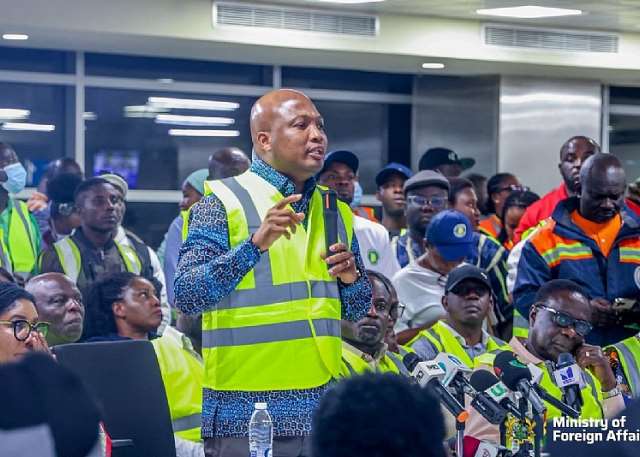
Walk through Abossey Okai or Tema and the signs of BRICS are already visible in Ghana’s economy. Spare parts and machinery arrive from Guangzhou. Pharmaceuticals and vehicles come from India. Gold flows out to Dubai. On 15 January 2026, Ghana’s Foreign Affairs Minister, Hon. Samuel Okudzeto Abalakwa, announced the cabinet’s approval for Ghana to apply for membership in BRICS during a joint press briefing with India’s External Affairs Minister in Accra.
The decision connects directly to the government’s “New Economy” agenda, aimed at charting a growth path free from the conditionalities imposed by a handful of international institutions. Trade data has long suggested a close economic relationship between Ghana and BRICS countries. Now, the government wants to formalise it.
BRICS started in the early 2000s as an acronym for Brazil, Russia, India, and China, describing fast-growing emerging economies. South Africa joined in 2010, turning BRIC into BRICS and giving Africa representation. Egypt, Ethiopia, Iran, the UAE, and Indonesia, which joined in 2025, have expanded membership to 11 countries, with Nigeria and others holding partner status.
The New Development Bank (NDB), headquartered in Shanghai, is BRICS’ main financial institution. It has approved over 120 projects worth about US$40 billion. New members are admitted on the condition that the original BRICS countries maintain at least 55% of the capital share. One of the group’s ongoing aims is to reduce reliance on the US dollar, a goal that remains unmet.
BRICS has evolved beyond a forum for emerging economies. It offers developing nations more options in an unpredictable global environment marked by economic fragmentation and geopolitical competition. Ghana’s interest in joining BRICS comes as the country moves from macroeconomic stabilisation to a focus on investment-led growth and structural transformation.
Years of economic turbulence, debt restructuring, and IMF-supported reforms have given way to progress in restoring macroeconomic stability. Discussions increasingly focus on moving from recovery to sustainable private-sector-driven growth. Against this backdrop, BRICS presents a chance to expand Ghana’s economic choices.
Government officials framed the application as part of a broader strategy to diversify partnerships and open new avenues for cooperation. This approach ties into Ghana’s broader ambitions around industrialisation, infrastructure development, job creation, and economic transformation.
Four main economic arguments support Ghana’s BRICS membership. First, Ghana’s export markets already align with BRICS. In 2025, the UAE accounted for 25.9% of Ghana’s exports, India 16.0%, South Africa 10.3%, and China 4.9%. Together, these four BRICS members took roughly 57% of Ghana’s export earnings. On imports, China supplied about 23% in the fourth quarter of 2025. Membership could formalise these relationships and open new channels for exports and investment.
Second, development financing options would expand. Ghana has recently completed a demanding IMF programme and now engages with the Fund through a Policy Coordination Instrument, which offers technical support but no financing. Access to the NDB for infrastructure projects in energy, rail, water, and digital sectors would increase Ghana’s access to long-term capital critical for growth.
Third, industrial and technology partnerships could deepen. During India’s External Affairs Minister’s visit, plans were announced to enhance cooperation in railways, pharmaceuticals, ICT, defence, agriculture, and science and technology. If Ghana negotiates local value addition in gold refining, cocoa processing, and pharmaceutical manufacturing, the growth benefits could extend beyond raw commodity exports.
Finally, membership could strengthen Ghana’s negotiating power in international forums, including on debt treatment, climate finance, and conditionality. Being part of more discussions can increase Ghana’s influence with partners like the Bretton Woods institutions.
South Africa’s experience since joining BRICS in 2010 offers a relevant example for Ghana. South Africa has used membership to deepen economic ties and raise its profile in global governance. Ghana’s application signals a desire to follow a similar path amid an evolving global landscape.
The formal application opens questions about the costs and benefits of membership and how Ghana’s businesses should position themselves as the process unfolds. The government’s announcement came without timelines or details on the next steps.
Ghana’s move to join BRICS comes at a moment when the global balance of economic power is shifting, and countries seek new alliances beyond traditional Western-led institutions. Whether BRICS membership will deliver on its promise remains to be seen.
According to 3News.