

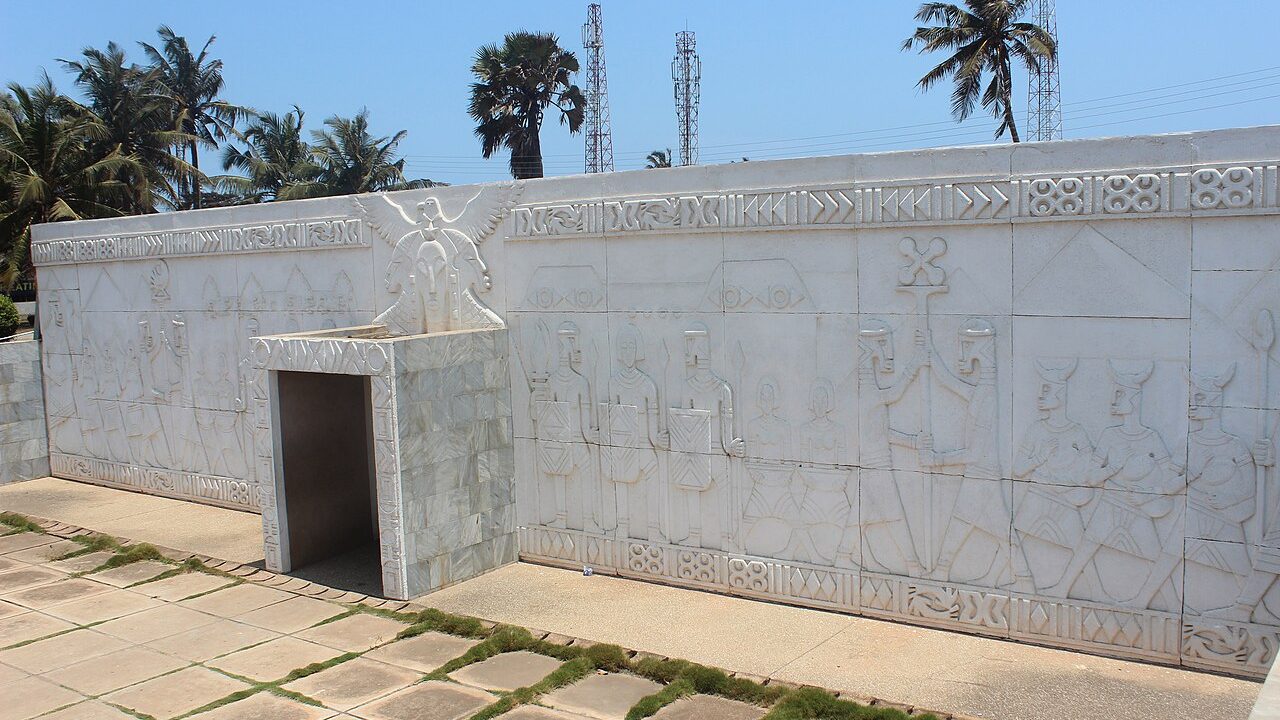

Kwame Nkrumah died in Bucharest on 27 April 1972, six years after soldiers overthrew him, and it took twenty years for his body to reach the patch of central Accra where he had announced Ghana’s freedom. He was buried first in Conakry, Guinea, the country that sheltered him in exile. His remains then came home to his birthplace, Nkroful, in the Western Region. Only in 1992 was he laid in the mausoleum that now draws visitors to the Kwame Nkrumah Memorial Park.
The site was chosen for what happened there. On the old Polo Grounds, at midnight as 5 March 1957 became 6 March, Nkrumah stood before a crowd and declared that Ghana was free forever.
A monument built by a soldier’s government
The man who brought Nkrumah to the Polo Grounds a final time was Jerry John Rawlings, then head of state. Sources differ slightly on when the work began, placing it around 1990 and 1991, but the park was established on 1 July 1992, the anniversary of Ghana becoming a republic, on five acres of the former colonial polo grounds. The politics were striking. Nkrumah’s government had been removed by the army and police in February 1966, and for years his name had been officially out of favour. A later military ruler was now giving him a state memorial.
Nkrumah had been abroad when the coup came on 24 February 1966, travelling on a peace mission connected to the Vietnam War. He never saw Ghana again. Guinea’s president, Ahmed Sékou Touré, took him in and named him honorary co-president, and he spent his last active years in Conakry writing and following events at home.
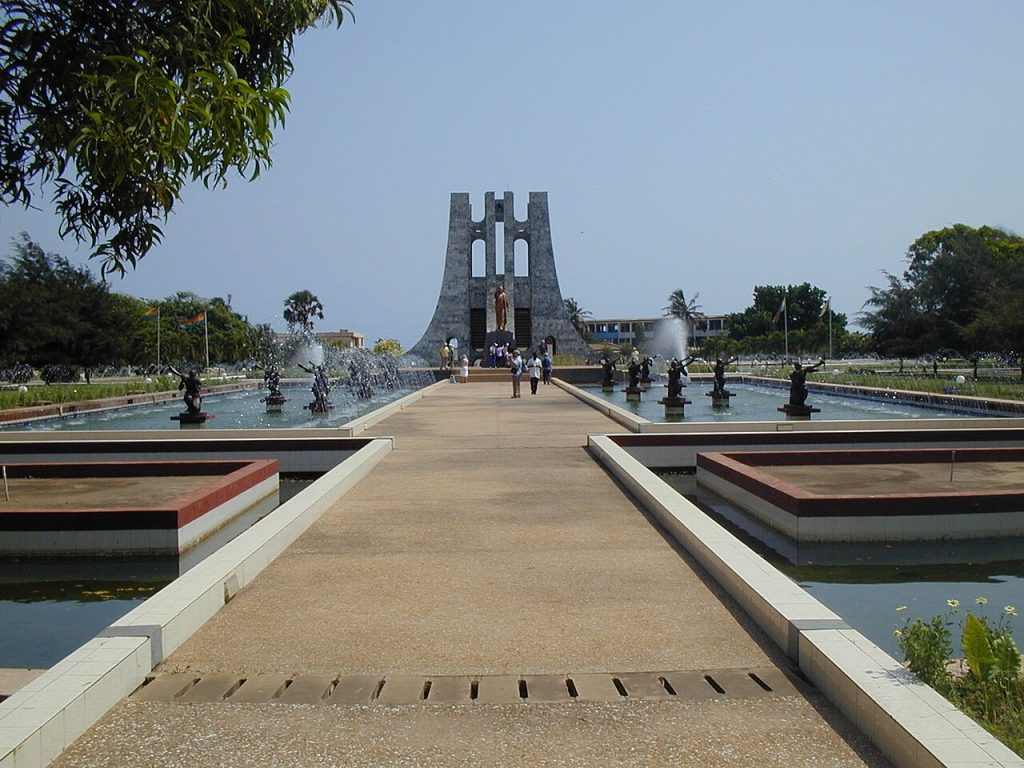
The mausoleum was designed by the Ghanaian architect Dr E. G. A. Don Arthur. Its shape is often read as an upturned sword, a reference to Akan symbols of authority and peace, and its Italian marble cladding, with a black star at the apex, makes it the most recognisable structure on the grounds. Inside lie Nkrumah and his Egyptian-born wife, Fathia, who died in Cairo in 2007 and was brought to rest beside him.
The closure and the rebuild
By the 2020s the park needed serious work. The Ministry of Tourism closed it in late May 2022, and rehabilitation formally began that July under the then minister, Dr Ibrahim Mohammed Awal. Two Ghanaian firms, Awacon Ghana Limited and Zaknap Consultancy, carried out the project.
President Nana Akufo-Addo commissioned the refurbished park on 4 July 2023. Before the closure it received around 90,000 visitors a year, and officials said at the reopening that they expected the new facilities to lift that figure past one million. That target is a long way above the park’s earlier numbers, and it remains the measure against which the investment will be judged.
Reported costs vary. The presidency’s announcement called it a ¢30 million project, while another account puts it at about US$3.5 million, drawn from a US$40 million World Bank tourism fund. The new park added a presidential library, an amphitheatre, a restaurant, a freedom hall, a gift shop, an audio-visual tunnel and a digital payment and access system. Akufo-Addo singled out a fountain area with synchronised audiovisuals, which he called “the first of its kind in West Africa”.
The project was one part of a wider heritage plan set out that day. The President also spoke of a museum and Heroes Park for the Big Six, a memorial park in Cape Coast for the Aborigines, a memorial enclave in Tamale for the founders of the Northern People’s Party, and museums at Bonwire and at Ejisu for Yaa Asantewaa. Some 6,000 frontline tourism workers were to receive customer-care training.
What a visitor finds there
The walk from the entrance leads past fountains and statues toward the mausoleum at the centre of the grounds. A bronze statue of Nkrumah stands with one arm raised. Close by is a museum holding objects from his life, including photographs and personal items from his years in office and in exile.
The park sits within easy reach of the High Street and the Old Parliament House, where much of the country’s early political life played out.

A grave with a political history
Few national monuments in West Africa carry this many reversals. The man honoured here was declared an enemy of the state by the government that replaced him, and his statue outside the Old Parliament House was pulled down after the 1966 coup. Its damaged remains are still kept in the park. Visitors can stand within a few metres of both the broken figure and the tomb, one put there by the people who removed him and the other by those who brought him back.