

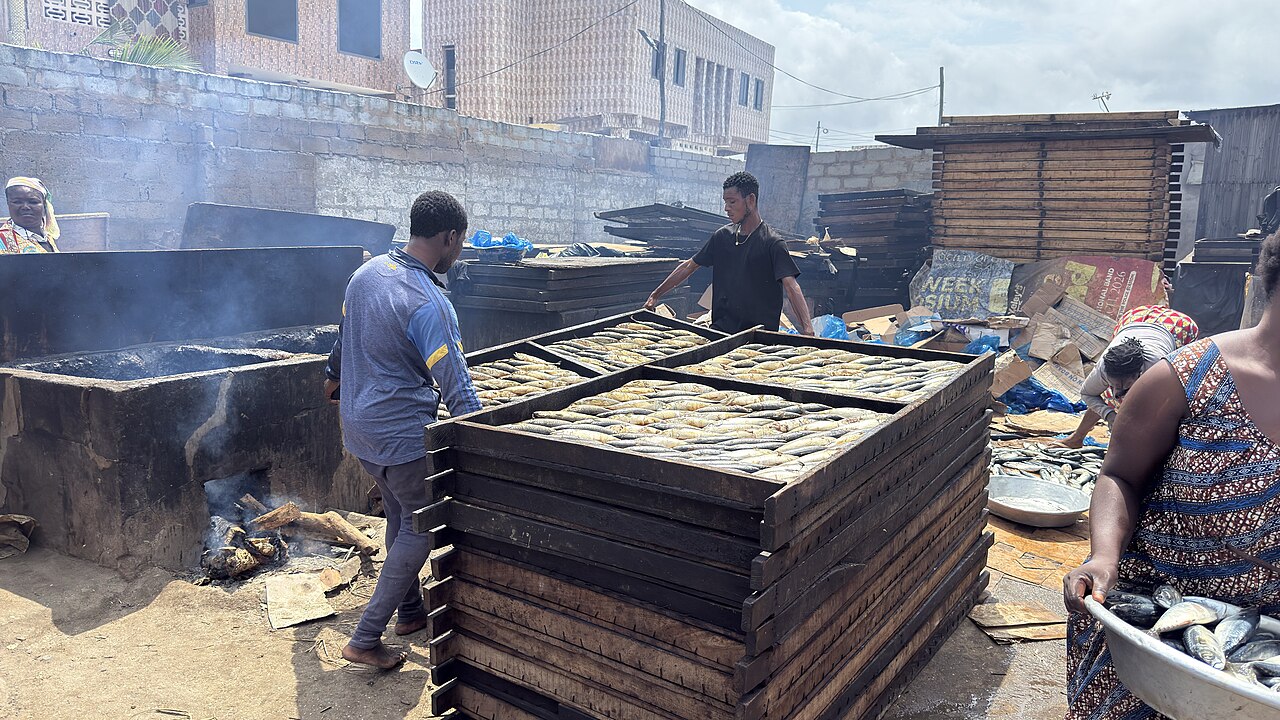

Most inventions named after an Accra neighbourhood never leave the city. The Chorkor smoker did. Built around a simple stack of removable wooden trays, the fish oven developed with the women of this coastal community became a standard piece of equipment for fish processors, and a 2024 study describes it as being in wide use across Africa. Its name still points back to a crowded fishing town on the western side of the capital.
The oven solved a real problem for the women who buy the catch from canoes and turn it into a product that can travel. Half a century later, it has a problem of its own.
Built with the women who used it
Fresh fish spoils quickly in Ghana’s heat, and smoking has long been the main way of keeping it. The fish most associated with the Chorkor oven is sardinella, which Ghanaians commonly call herring. It is smoked without salt, and small fish are not gutted. Processors cook it over a high fire and then smoke-dry it over a low fire for anywhere from one to five days and nights. Lightly dried fish keeps for up to a week, while hard-dried fish can last several months.
Before the new design, a common method used a traditional rectangular oven with a fixed surface. The improved version came out of work by Ghana’s Food Research Institute with the women of Chorkor and with help from a project of the United Nations Food and Agriculture Organization. Sources disagree on the exact date. The Ghana News Agency and several technical reports give 1969, while others place the development in the early 1970s.
Why the trays changed the trade
The important change was the removable tray. Fish is spread across several trays, which are then stacked on top of the oven. A processor can therefore smoke a much larger quantity at one time and move layers around as they dry.
The benefits recorded for the design are larger capacity, lower fuelwood consumption and a better finished product. For women paying for firewood out of small trading margins, those savings counted. The oven has drawbacks too. It costs more to set up, since it needs sawn planks, wire mesh and a skilled carpenter, and it is less suited to batches of fish in mixed sizes.
The trouble with the smoke
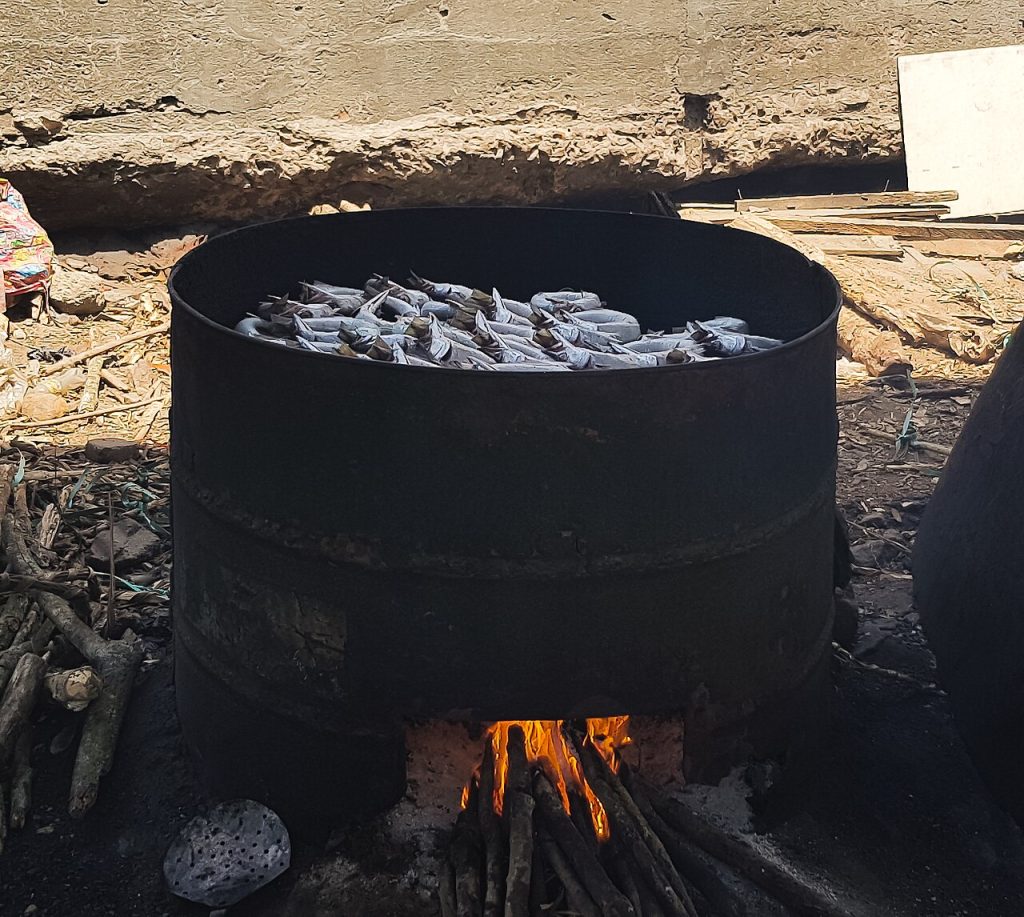
The same firewood that gives Ghanaian smoked fish its flavour also carries a risk. Researchers have found high levels of polycyclic aromatic hydrocarbons, or PAHs, in fish smoked on both the Chorkor oven and metal drum kilns, and they trace the contamination to the use of firewood as smoking fuel. PAHs are a group of chemicals produced when organic material burns, and some are classed as cancer-causing.
The FAO’s regional office for Africa has described the level of contaminants in smoke as a great challenge for the sector. Dr Amy Atter, a principal research scientist at the Food Research Institute, has said that smoked fish from this technology can carry PAH levels above international limits, and she describes the compounds as “associated with cancer risks when consumed frequently”.
The concern reaches beyond the people eating the fish. Atter told the Ghana News Agency in 2024 that women spend “a minimum of six hours every day” in smoke from basic wood-fired ovens, and studies have linked heavy exposure to cataracts, poor eyesight, shortness of breath, wheezing and chronic cough. Contamination can also shut a product out of stricter export markets such as the European Union, which sets legal limits for PAHs in smoked fish.

The search for a safer oven
The best-known attempt at a replacement came in 2016, when the USAID-funded Sustainable Fisheries Management Project developed the Ahotor oven to improve fuel efficiency, cut smoke and lower PAH contamination. It struggled in the yards where it mattered. According to Atter, “many processors found the original Ahotor oven expensive, difficult to operate, and with some challenges, leading to limited uptake”.
In 2022 the Food Research Institute, working with the Fisheries Commission and other partners through the EU-funded HealthyFoodAfrica project, redesigned it. The modified Ahotor can run on charcoal, firewood or liquefied petroleum gas, and it has a larger combustion chamber and tube for faster cooking. Researchers also produced a cheaper option: a retrofitted Chorkor oven “fitted with a fat-collecting tray to reduce harmful contamination”. Fisheries scientist Dr Emmanuel Kwarteng says it keeps the familiar design and materials while adding safety features “at a significantly lower cost”.
Both are now being tested against the original. A pilot reported in September 2026, led in Ghana by Atter with the University of Bergen and funded by the Research Council of Norway, covers six fish-processing communities: Akosombo, Kpong, Ahwiam, Joma, Vodza and Saltpond-Ankaful. Atter says scientific evidence is still needed to show how far the new ovens reduce contamination. Until those results arrive, the traditional Chorkor remains the most widely used smoker among Ghana’s fish processors, and the name of a crowded Accra fishing town stays attached to both the problem and the most likely fix.