
Pupils at Mantukwa D/A Junior High School spent years learning in a Church of Pentecost building. Form Three students had to use a classroom at the nearby primary school because there was no dedicated JHS block. At Atababo, the situation was worse. Pupils attended classes in a mud structure, and some walked over four kilometres to reach the nearest JHS.
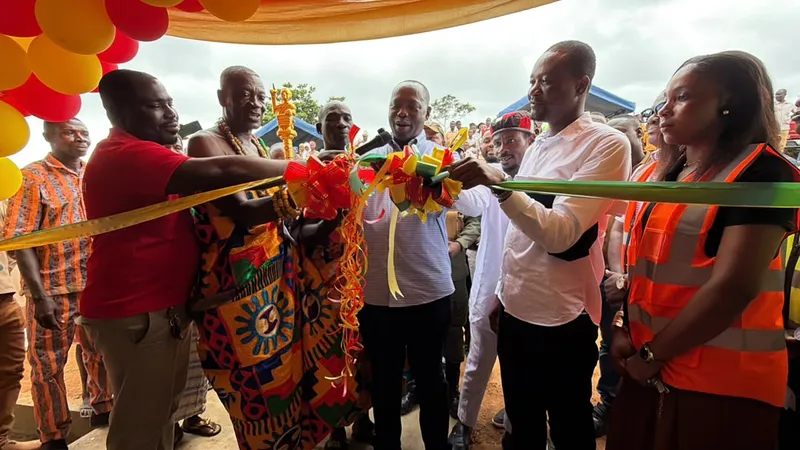
That changed with the commissioning of two new three-unit JHS blocks at Mantukwa and Atababo in the Ellembelle District of the Western Region. The buildings come with toilet facilities and are expected to provide safer, more suitable environments for learning.
The projects were funded through the District Assemblies Common Fund and the Ellembelle District Assembly’s Internally Generated Funds (IGF). The Mantukwa block was financed with money from the Common Fund, while Atababo’s came from the assembly’s IGF.
Emmanuel Armah-Kofi Buah, the Ellembelle Member of Parliament and Minister for Lands and Natural Resources, said the projects aim to improve access to quality education and reduce inequalities between rural and urban areas.
“For communities like Atababo, where children have been walking for more than four kilometres before they get to JHS, this is complete transformation,” he told Accra Posts. “This is resetting Ghana and levelling the playing field for children in rural areas to close that inequality gap in education.”
Mr Buah said bringing JHS education closer to children in rural communities would give them a better chance to compete with their peers in towns and cities. He added that investment in school infrastructure would open doors for more students from rural areas to pursue higher education.
“It will translate into children in these villages competing meaningfully with children in the cities. So when you go to the universities, you’re not only going to see the privileged few there; you’ll see Atababo children also in the university,” he said.
Joseph Agyekum, the District Chief Executive for Ellembelle, said education is a shared responsibility. After the government handed over the schools, he urged residents to take care of the new facilities.
“As a government, we’ve done our part. We’ve handed over the school to the community, so the responsibility of maintenance now lies on the community to make sure they maintain the school that we’ve just given to them,” Mr Agyekum said.
He added that the assembly has built 12 schools in less than two years, with several others under construction. Alongside the classrooms, three Community-based Health Planning and Services (CHPS) compounds have been delivered in the district within the first year.
For pupils like Aishatu Karim, a Form Three student at Mantukwa D/A JHS, the new block means a huge change. She said the lack of proper facilities had made learning difficult in the past.
The new classrooms at Atababo and Mantukwa will end the need to study in churches or mud buildings and cut down long walks to school. They offer a better setting for teaching and learning, which could help children from these rural communities keep up with their urban counterparts.
These school blocks are part of wider efforts in Ellembelle to close the gap in education access and quality. The changes may still be small, but for the children and families involved, the difference will be clear every school day.
According to 3News.