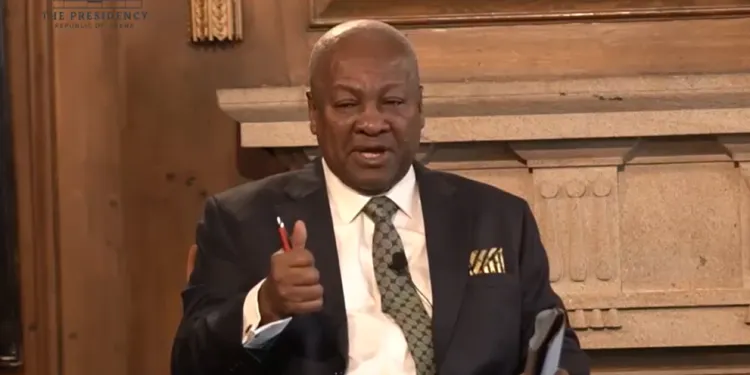
President John Dramani Mahama said the fight against terrorism in West Africa and the Sahel requires stronger ties between countries and regions. Speaking at the Council on Foreign Relations in New York on September 27, he linked the rise in insecurity in the Sahel to the fallout from the Libya conflict, the spread of arms, and the movement of terrorist groups into the area.
He pointed to the series of military coups in the Sahel region as part of this broader security problem. These events, he said, should be seen in the context of growing instability fueled by these factors.
Mahama urged for more dialogue between the Economic Community of West African States (ECOWAS) and the Alliance of Sahel States (AES). He said rebuilding relations between these two groups is necessary to tackle the security threats effectively.
“The fight against terrorism cannot be addressed by individual countries or regions alone,” Mahama said. He stressed the need for regional and international cooperation to deal with the challenge.
Ghana, under Mahama’s leadership, is taking steps to guard its borders. The president said the country is increasing surveillance and intelligence sharing with its neighbours as part of efforts to protect its territory.
These measures are part of Ghana’s wider plan to keep the country safe while working with other nations to handle the regional security issues.
The instability in the Sahel has worsened since the conflict in Libya ended in 2011. The fall of Muammar Gaddafi’s regime left a power vacuum that allowed weapons and fighters to spread across the region. This has made it easier for extremist groups to gain ground.
Several countries in the Sahel have since experienced military takeovers, which some analysts link to the security crisis. Mahama’s remarks suggest these coups reflect deeper challenges tied to terrorism and instability.
ECOWAS, which includes Ghana and other West African countries, has often taken a lead role in responding to crises in the region. The AES, formed in 2021, brings together Burkina Faso, Chad, Mali, Mauritania, and Niger, aiming to address security concerns in the Sahel together.
Tensions have existed between ECOWAS and AES, especially after ECOWAS imposed sanctions following coups in some AES member states. Mahama’s call for dialogue between the two groups points to a desire to ease these tensions and find common ground.
Terrorism in the Sahel has spilled over into neighbouring countries, raising concerns for Ghana and other coastal states. The country’s efforts to improve border security and share intelligence reflect its recognition of these dangers.
Mahama’s speech at the Council on Foreign Relations came in a context where global attention remains focused on the Sahel, a region struggling with jihadist violence and political instability.
His comments underline the limits of any single country acting alone against these threats. Instead, they call for a collective approach involving regional blocs and the international community.
Ghana’s moves to enhance security coordination with neighbours also suggest a practical response to the risks posed by the Sahel crisis. This approach may help prevent the spread of violence into West Africa’s coastal states.
Mahama’s message at the New York forum adds to calls from other leaders for more cooperation to restore stability in the Sahel. But it also highlights the ongoing challenge of bridging divides between regional groups with different interests and approaches.
According to Joy Online.