
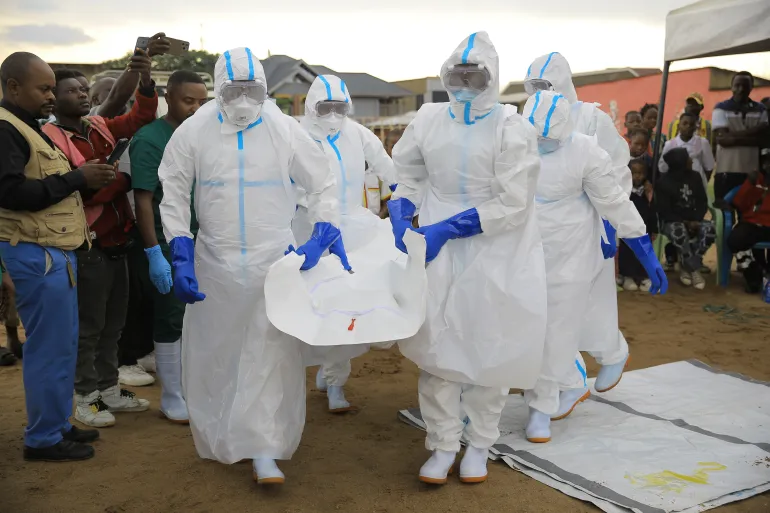
Nigeria has confirmed its first Ebola case in the capital, Abuja, after a woman travelling from Uganda tested positive for the virus. The patient began showing symptoms on October 7 and was admitted to a private hospital on October 11, according to Nigeria’s Federal Ministry of Health and Social Welfare.
Health Minister Muhammad Pate announced that authorities are tracing 44 people who had contact with the woman. “We are doing everything possible to contain this case by tracing all the contacts the individual may have had,” he said.
This case comes amid an outbreak in the Democratic Republic of Congo and recent infections in Kenya that have raised concerns about Ebola spreading across Africa. The DRC has reported more than 9,000 cases and 4,000 deaths since May. The European Centre for Disease Prevention and Control describes it as the second-largest Ebola epidemic on record. The outbreak involves the Bundibugyo strain, for which no licensed vaccine or specific treatment exists.
Kenya confirmed its ninth Ebola case on Tuesday. The patient is a 24-year-old man who had been quarantined prior to testing positive. Kenya’s Ministry of Health said he was isolated at the first sign of illness, tested, and started treatment immediately after confirmation.
The man is a close family member of Kenya’s first Ebola patient, who had travelled from the DRC through Uganda before arriving in Kenya and dying in Nairobi on October 5. Director-General for Health Patrick Amoth said, “All nine cases belong to one cluster, and as of today there is no evidence of transmission outside this group.”
Eight patients are stable and responding well to treatment, while 134 of 135 contacts have been traced and quarantined, Amoth added. Most contacts will soon complete the 21-day monitoring period and may return home from October 25. The ministry urged communities to welcome them back, stating they “pose no risk of infection.”
Kenya has not imposed restrictions on travel, trade, or public gatherings despite the outbreak. The ministry said no infections have occurred within quarantine facilities and that infection-prevention measures continue to protect health workers.
Uganda had reported Ebola cases in the recent past but was later declared free of the virus. The woman diagnosed in Abuja had travelled from Uganda, linking the new Nigerian case to the broader regional outbreak.
Health officials in Nigeria have not announced further cases but are intensifying surveillance and contact tracing. The emergence of Ebola in Abuja, a major urban centre, raises fears about potential spread in a densely populated city with extensive travel connections.
As of now, Nigeria’s response hinges on containment efforts focused on those who had contact with the patient. The situation is evolving rapidly amid the wider regional crisis.
According to Joy Online.