Kylian Mbappé ended a 20-year partnership with Nike in September to join Swiss sportswear brand On, delivering a blow to the US giant’s hold over football’s elite stars. The Real Madrid striker’s defection came as Nike wrestles with a steep decline in market value and struggles to maintain its dominance in a competitive sportswear landscape.
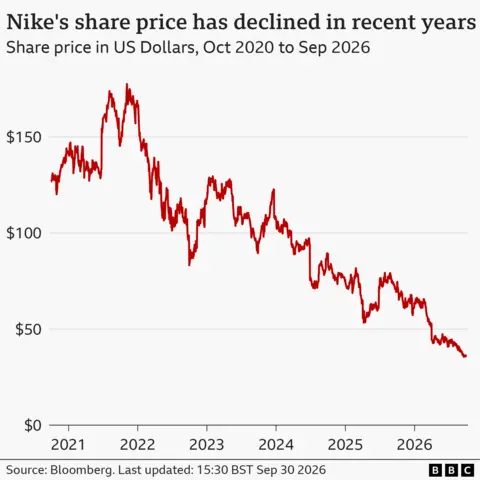
Nike’s share price has plunged 75% over five years, wiping out hundreds of billions of dollars in market value. Last month, the company was removed from the S&P 100 index of the biggest US blue-chip firms. The drop reflects several strategic missteps under former CEO John Donahoe, who pushed the brand’s pivot to online direct sales and digital operations at the expense of product innovation.
Matt Powell, a veteran analyst and adviser in the sports retail sector, said Nike’s errors included cutting ties with retailers to sell mostly direct-to-consumer online and expanding availability of limited-edition shoes. “The more broadly available those shoes became, the fewer people were interested,” Powell told Accra Posts.
Powell also criticised the company’s shift of research and development investment away from new products toward digital platforms. “Someone jokingly said they were trying to turn Nike into eBay,” he said. Donahoe’s four-year tenure coincided with Nike’s share price collapse, despite pandemic-driven online sales growth early on.
Elliott Hill, a Nike veteran brought out of retirement two years ago to lead a turnaround plan dubbed “Sport Offense,” acknowledged the challenges. The latest quarterly revenues of $11bn (£8.3bn) fell short of analysts’ expectations, hit by a 26% sales drop in China and a decline in the Jordan brand globally. Hill said the company had been “oversupplying” Jordan retro shoes and would now reduce volume and focus on sportswear and growth in China.
Hill said Nike had “some great moments” with Mbappé over two decades. “We wish him much success as he makes the move,” he said during the company’s earnings call, adding Nike still has a “great stable of athletes.”
Mbappé’s move to On follows that of young World Cup winner Lamine Yamal, who left Nike for Adidas, citing the chance to stand out from Nike’s star-studded roster. Mbappé said On would see him “surrounded by innovators who dream of the same things I do,” a remark interpreted by some as a dig at Nike.
Tim Derdenger, an academic specialising in marketing and strategy, compared Mbappé’s switch to Nike’s gamble in the 1980s signing Michael Jordan, who chose Nike over Converse and Adidas because it gave him a chance to become synonymous with a single brand. “Athletes have egos, and those egos want them to be a part of something big and that they’re the ones that are helping drive that change, that growth,” Derdenger said.
Nike’s history of associating with generational talents spans Michael Jordan, Serena Williams, Tiger Woods, and Cristiano Ronaldo. Jordan’s Air Jordan line was built around the NBA rookie in the mid-1980s, despite the red and black colours breaking league rules. Nike paid the fines and turned the controversy into marketing.
The firm still retains partnerships with some of these stars, though Woods ended his association with Nike in 2024. Nike’s current roster includes athletes like Rory McIlroy and Vinicius Junior, but losing Mbappé and Yamal to rival brands signals a shift.
Powell believes Nike will remain number one globally, with millions of young fans still loyal to the Swoosh. “Will Nike be the gorilla they once were? I don’t think so. Can the brand come back to growth and profitability? Yes,” he said. Powell said Nike’s turnaround plan would start showing results next year but warned, “When you shut down innovation, you don’t turn it back on, and it goes right back to full speed.”
Nike’s recent troubles have exposed cracks in a company that once defined sportswear innovation and athlete partnerships. The departure of its biggest football star signals the challenges facing a firm trying to reclaim its place at the top while rivals like On and Hoka gain ground.
According to Joy Online.