
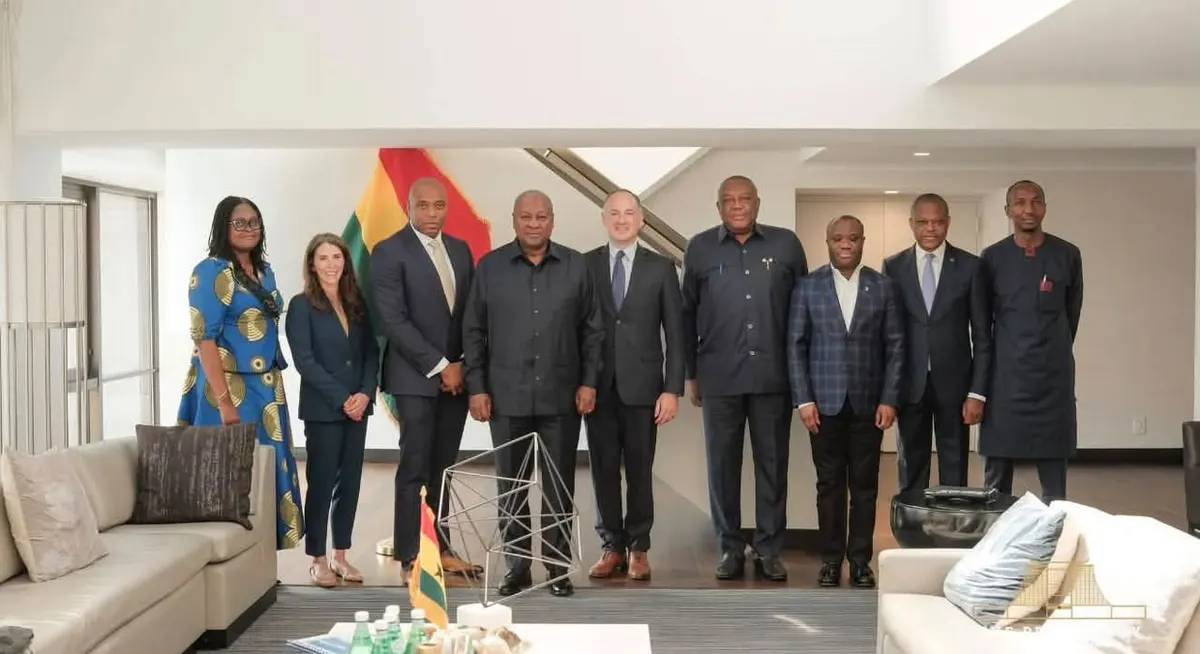
President John Dramani Mahama has taken a major step toward bringing back Ghana’s national airline after meeting with senior Boeing executives during the 81st United Nations General Assembly in New York. The talks focused on more than just buying planes. Mahama said Ghana wants a lasting partnership that builds the country’s aviation industry from the ground up.
The meeting follows earlier discussions between Ghana’s Ambassador to the United States, H.E. Victor Emmanuel Smith, and Boeing officials. These talks aim to develop a strategic relationship between the country and the global aerospace firm.
At the New York meeting, President Mahama made it clear that Ghana’s interest goes beyond acquiring aircraft. “Ghana does not want its relationship with Boeing to be defined simply by the purchase of aircraft. We want a strategic partnership that helps us build an aviation ecosystem—creating skilled jobs, transferring technology, strengthening our industrial base, and positioning Ghana as an aviation and logistics hub for West Africa,” he said.
Mahama connected this ambition to his broader economic goals. “As we Reset Ghana, we are looking for partners prepared to invest with us, build capacity with us, and share in the prosperity we create. Boeing can be one of those strategic partners,” he added.
The discussions focused on rebuilding Ghana’s national airline, which has been dormant for some time. Boeing is expected to provide technical support to get the carrier back in operation. Beyond that, the talks covered aviation infrastructure, human capital development, and technical capacity, all necessary for a competitive aviation sector.
One major area under consideration is the establishment of a regional Maintenance, Repair, and Overhaul (MRO) hub in Ghana. Such a facility would serve airlines across West Africa and possibly the wider African continent. This would position Ghana as a centre for aircraft maintenance and related services, potentially attracting business from the region.
Training and skills development were also on the table. The partnership aims to create high-value jobs for young Ghanaians by focusing on aviation training and technology transfer. This approach targets not just immediate needs but building long-term capacity in the sector.
If the partnership moves forward, it could cover a wide range of activities beyond aircraft acquisition. These include maintenance, training, technology sharing, and industrial development. This broad scope reflects Ghana’s ambition to grow its aviation industry in a sustainable way.
The talks with Boeing come as Ghana seeks to reset its economy and create new investment opportunities. The government sees the aviation sector as one area where it can build skills, create jobs, and support industrial growth.
The next steps for the Ghanaian government and Boeing have not been announced. But the discussions signal a serious effort to revive the national carrier and build a competitive aviation ecosystem in the country.
The relationship between Ghana and Boeing now moves from initial talks to potentially detailed agreements that could shape the future of aviation in the region.
According to 3News.