On Saturday, 18 August 1979, soldiers of the Armed Forces Revolutionary Council packed dynamite into Makola No. 1 Market and brought the whole thing down.
The market had stood in central Accra since the 1920s. It was where the city bought its sugar, milk, soap, cloth and tinned fish, and the women who ran it were among the most powerful traders in West Africa. By the end of that weekend there was rubble where the stalls had been, and the plan for the site was a park named after the man in charge of the country, Flight Lieutenant Jerry John Rawlings.
A market accused of kalabule
The AFRC seized power on 4 June 1979 and ruled for 112 days, until it handed over to Hilla Limann’s elected government on 24 September. Its stated mission was “house cleaning”: rooting out corruption before civilian rule returned.
Ghana in 1979 was short of almost everything. Prices climbed weekly, and the word on every street was kalabule, the Ghanaian term for hoarding goods and selling them above the controlled price. The soldiers decided Makola was the headquarters of kalabule. Traders were flogged in public, goods were seized and sold off at “control prices”, and market women became the face of the country’s economic misery.
The account of Makola’s destruction preserved in later testimony is blunt. Witnesses told the National Reconciliation Commission decades later that soldiers cordoned off the market and blocked traders from going in to remove their wares. Goods were looted. One story that circulated at the time, never proven, held that market women had poured urine on soldiers who demanded lower prices. It was repeated often enough to serve as a justification.
Why the market women were the target
The researcher Barbara Harrell-Bond, who was in Ghana in 1979, wrote that the vast majority of Makola’s traders were women and that this made women the main target of “revolutionary action”. Claire Robertson’s study of Accra’s traders, published in 1983 under the title “The Death of Makola and Other Tragedies”, made the same point from a different angle: the traders were blamed for shortages they did not create.
The logic was simple and wrong. Ghana’s shortages came from falling cocoa income, a collapsing currency, import controls and years of economic mismanagement. The women at Makola sat at the end of that chain. They were visible, they handled cash, and they could be punished in front of a crowd.
What the city lost
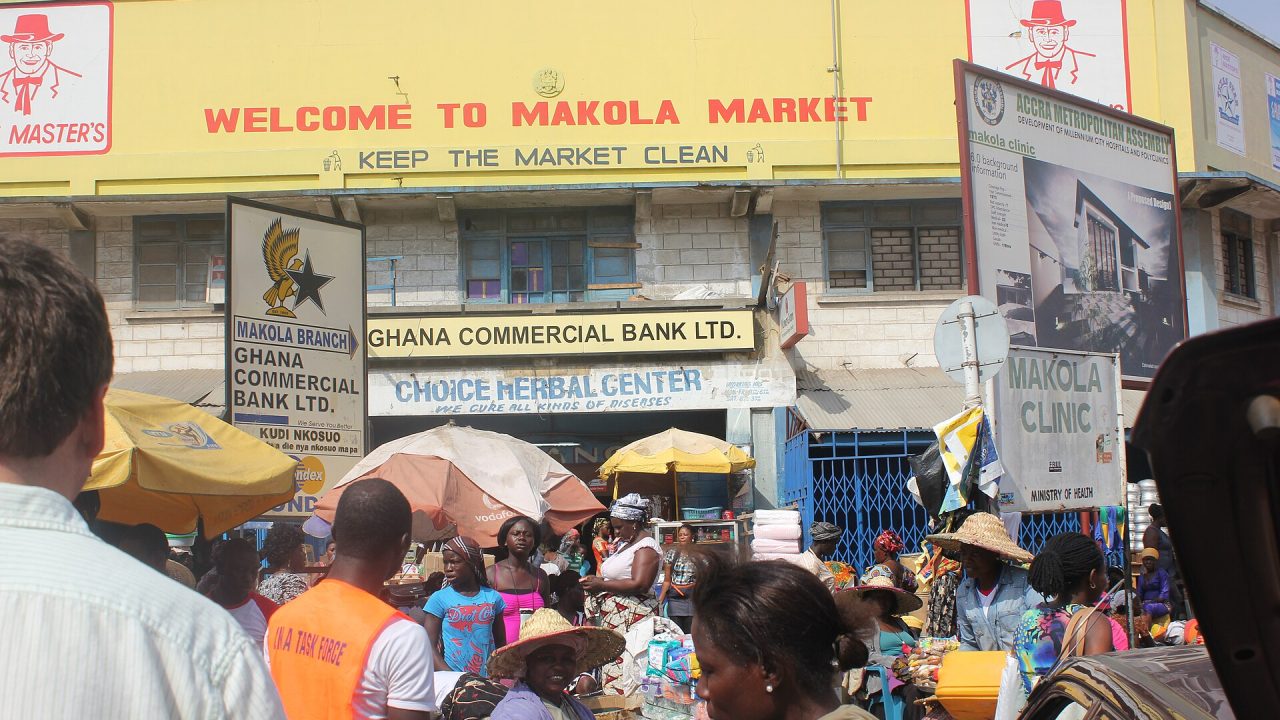
Makola was more than a building. Traders held their places through long family lines, credit moved between women who had known each other for decades, and market queens settled disputes before they ever reached a court. Blowing up the structure broke the physical centre of that system, and it pushed trading onto the surrounding streets.
Anyone who has tried to drive past Makola on a weekday since knows the result. Trading never left central Accra. It spread along the pavements of Kojo Thompson Road, Knutsford Avenue and the lanes around Okaishie, because nothing else was built to take its place fast enough.
Rawlings Park
The cleared land was named Rawlings Park. The name stuck for the area around it, and for years afterwards Accra residents gave directions by the park and its bus stops without thinking about how it got there. Over time, parts of the area were built up again for trading and commercial use, and in recent years the name itself has become a point of argument, with some commentators asking whether a market site destroyed by the state should carry the name of the man who led that state.
The traders came back
The AFRC left office in September 1979. Rawlings returned by coup on 31 December 1981 and ruled until 2001. Through all of it, Accra’s market women kept trading, because the city could not eat without them. The Makola Market that exists today, and the huge informal trading zone around it, is the direct descendant of the one that was dynamited.
Ask an older trader at Makola about 1979 and many will name the date before they name the government. The building was cleared in a weekend; the market has been standing on the same few streets for more than forty-five years since.