
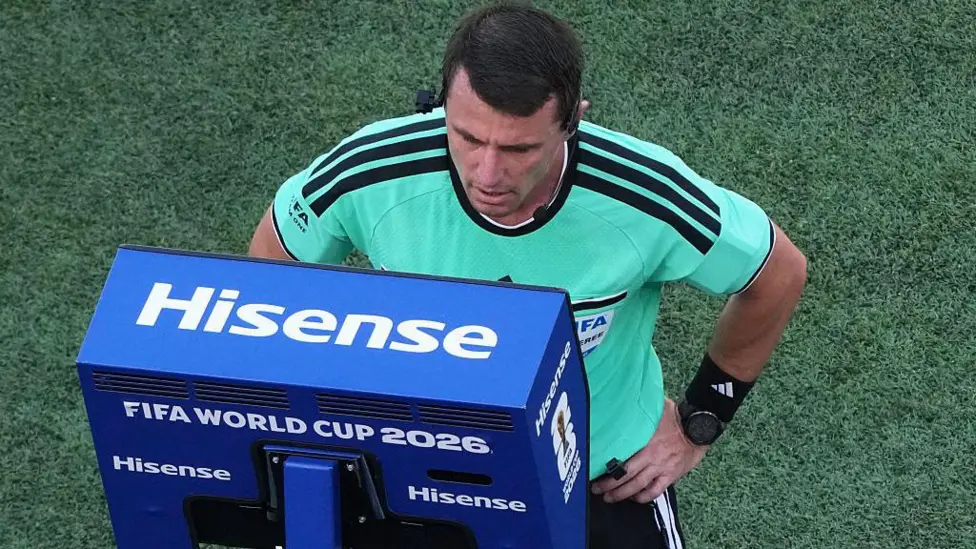
Referees Told to Use VAR Only When Blatant Errors Occur
European refereeing officials have instructed referees to use Video Assistant Referees (VAR) only when there are "blatantly incorrect" decisions or clear missed incidents.
Chief refereeing officers from all 55 European national football associations met with UEFA refereeing officials and a representative from the International Football Association Board (IFAB) to address recent changes to the game's laws. The meeting aimed to return to the original scope of VAR, which was introduced in 2018 by football's rulemakers IFAB.
Reverting to Original Aims
When VAR was first introduced, its "philosophy" was "minimum interference – maximum benefit". The intention was to reduce "unfairness caused by clear and obvious errors or serious missed incidents" relating to goals, penalties, direct red cards, and mistaken identity. UEFA said that at its recent meeting, refereeing bosses agreed a return to those original aims is needed.
"It was reiterated that, in accordance with protocol, VAR must only intervene in situations of 'clear and obvious' error, ie. when a referee decision is blatantly incorrect or when the referee has missed a clear incident," UEFA said in a statement. "VAR is not meant to re-referee the game; it is an essential support to the referees, who must remain at the centre of all decision-making."
Limiting Microscopic Reviews
Lengthy and microscopic reviews of VAR decisions are often a symptom of the decision on the field not being clearly and obviously incorrect. According to UEFA, these reviews should be limited to prevent unnecessary delays in the game. Officials acknowledged recent clarification from IFAB around the correct interpretation of the "mistaken identity" rule introduced before this summer's World Cup.
IFAB clarified that VAR can only review cautions to "identify the player who committed the offence that was penalised, not to review or alter the offence". This clarification was made after Switzerland's Breel Embolo was sent off as a result of the new law following a controversial second yellow card for simulation against Argentina.
Support for Recent Rule Changes
There was also "unanimous support" for recent rule changes designed to reduce unnecessary delays, including time limits on goal-kicks, throw-ins, and substitutions, and new regulations around on-field injuries and goalkeeper tactical timeouts. These changes aim to improve the flow of the game and reduce the amount of time spent on VAR decisions.
Analysis and Debate
The implementation of VAR has been a subject of debate, with many managers and fans questioning its use. UEFA's statement of intent sounds positive, but the problem lies in the subjective nature of "clear and obvious error". What one manager might consider a blatant mistake, another might see as a fair call.
The debate around VAR will likely continue, with many arguments around the merits of individual decisions. However, the recent clarification from UEFA and IFAB aims to improve the use of VAR and reduce unnecessary delays in the game.
Source: Joy Online