
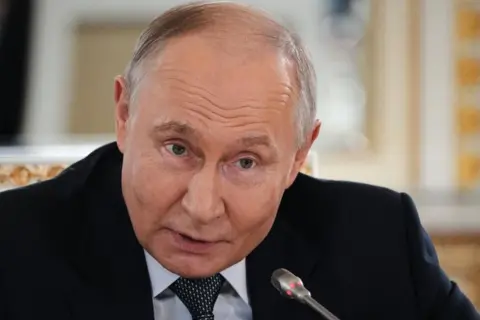
Vladimir Putin has warned that Russia will resort to all available weapons if Kaliningrad, its Baltic exclave, faces a direct attack. Speaking at the Valdai foreign policy forum this week, the Russian president said Moscow was prepared to respond with force, including nuclear arms, should NATO attempt to blockade the territory.
Putin insisted Russia was not threatening the West. Instead, he framed his comments as a reaction to Western leaders who, he said, had suggested a war with Russia could break out in 2029 or 2030. He accused NATO of preparing to isolate Kaliningrad, which borders Lithuania and Poland, and described Western naval exercises in the Baltic Sea as serious threats.
“If it comes to a direct attack on the Russian Federation, in this case we are talking about Kaliningrad but possibly some other territories, of course the issue of use by the Russian Federation of all arms at the disposal of our country will inevitably and immediately be on the agenda,” Putin said.
He added that Russia would respond if faced with aggression, urging European citizens to understand the risks. “We are not threatening anyone. We do not intend to attack anyone in 2029, in 2030, in 2050. But if we come across an aggression we will have to respond.”
Putin claimed Russia’s nuclear arsenal was “unparalleled” despite acknowledging the UK and France also maintain nuclear weapons. He drew an analogy to a gun on a theatre stage that, once present, will ultimately be fired, suggesting the threat of nuclear conflict was unavoidable in the current geopolitical climate.
The Russian leader repeated his narrative that the West provoked the war in Ukraine, which Moscow launched in February 2022. He portrayed Russia’s attacks on Ukrainian economic targets as retaliation for Ukrainian strikes on Russian oil refineries and ships in the Black Sea. Putin said Russia had lost about 1% of its GDP due to Ukrainian refinery attacks but insisted Ukraine’s strikes were the initial provocation.
Western officials have condemned Russia’s strikes on civilian infrastructure in Ukraine, including a drone attack on a key bridge in Kyiv on Thursday. Moscow has stepped up attacks on Ukraine’s energy infrastructure each winter since the war began.
In the Baltics and Poland, tensions have escalated amid a wave of hybrid warfare incidents blamed on Russia. Last week, Poland reported a Russian helicopter entering its airspace near Kaliningrad, and Lithuania said drones had repeatedly violated its airspace, leaving its population feeling “constantly threatened.”
German Chancellor Friedrich Merz said on Thursday that Germany was preparing for further hybrid attacks, including serious ones. The warning followed the discovery in August of a drone armed with explosives on the tarmac at Leipzig airport, near Ukrainian cargo planes.
NATO Secretary General Mark Rutte insisted on Wednesday that the alliance’s exercises and activities posed no threat to Russia and called Kremlin messaging “absolutely not called for and not helpful.”
Lithuania’s prime minister told the BBC last week that the country had evacuation plans prepared in case of a Russian invasion. Thousands of NATO troops are stationed in Lithuania, guarding the narrow Suwalki Gap, the strip of land connecting Kaliningrad and Belarus that Western officials fear could be used by Russia for a land assault on Lithuanian territory.
Putin also addressed the broader danger of modern warfare, warning that automation and digitalisation risk turning war into a game. “This leads to degradation and sliding back of humanity to barbarity,” he said. He called for a rewriting of warfare rules and flagged the growing threat posed by artificial intelligence.
The speech captured Moscow’s continued defiance amid rising tensions in Eastern Europe, where Russia’s military actions and nuclear threats have escalated fears of a broader conflict. Putin’s remarks suggest Kaliningrad will remain a flashpoint as NATO and Russia continue their standoff.
According to Joy Online.