
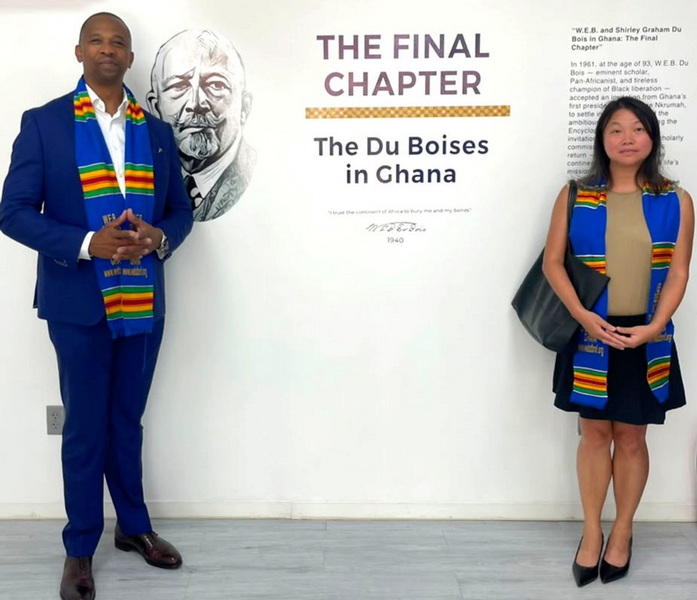
Walter T. Mosley laid a wreath at the tomb of Dr. W.E.B. Du Bois inside the mausoleum at the W.E.B. Du Bois Memorial Centre for Pan-African Culture in Accra. The New York State Secretary’s visit on June 2024 was a private tour of the Centre’s photograph exhibit and document preservation lab, part of a programme arranged by Maurice Cheetham, founder of Diaspora Bridge Consulting.
Du Bois moved to Ghana in 1961, invited by President Kwame Nkrumah to lead the Encyclopedia Africana, a project documenting African history and achievements. He became a Ghanaian citizen, living in the bungalow on First Circular Road until his death on August 27, 1963. His remains, along with those of his wife Shirley Graham Du Bois, were reinterred at the memorial site in 1985 by then-President Jerry John Rawlings.
Mosley’s tour came as the Centre undergoes renovations four decades after its opening. The bungalow where Du Bois lived remains closed to visitors. Instead, Mosley saw the photographic record of Du Bois’s life, from his early scholarly work in the United States to his final years in Accra. The preservation lab protects papers, books, and records tied to Du Bois for future researchers.
After the tour, Mosley met Japhet Aryiku, Executive Director of the W.E.B. Du Bois Museum Foundation. The Foundation, formed in 2019, works with the Ghanaian government to redevelop the Centre into a museum complex that includes a library, conference centre, art theatre, and guest accommodation. Board members have restored the bungalow, but the next phase awaits a wider fundraising campaign.
Discussions focused on how Mosley could connect the Foundation to New York philanthropic foundations supporting history and education, diaspora investors with Ghana ties, and government and civic networks interested in Africa partnerships. Du Bois’s career is closely linked to New York City, where he co-founded the NAACP in 1909 and edited its magazine, The Crisis, for over 20 years. The Foundation’s partnership agreement with Ghana was signed in New York City in 2021.
Du Bois insisted that African history deserved to be documented and preserved. The bungalow in Cantonments was where he ended that fight, and where it continues for visitors today. The Centre’s future depends on travellers making the trip, donors funding the work, and officials like Mosley opening their networks.
The W.E.B. Du Bois Memorial Centre remains open during renovations, with typical hours Monday to Friday, 9 a.m. to 4 p.m., and Saturday, 10 a.m. to 3 p.m. Visitors should confirm which areas are accessible before arrival.
According to Joy Online.