
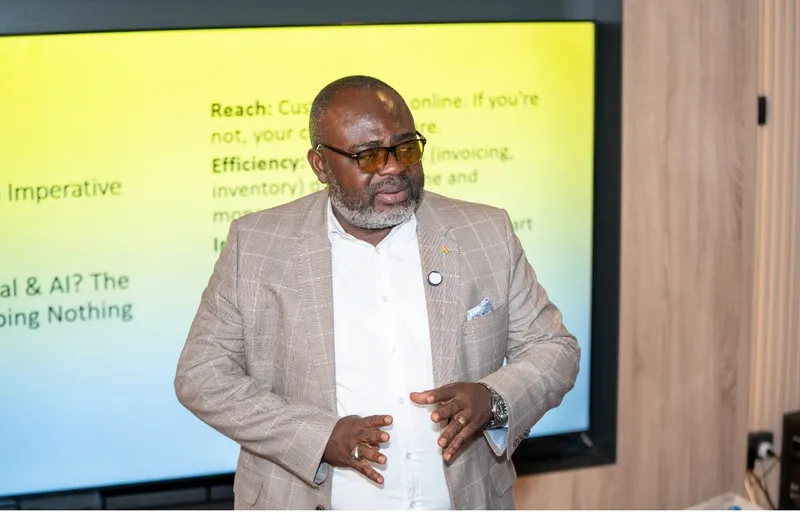
Fewer than 5 percent of Ghanaian micro, small, and medium enterprises currently use artificial intelligence, but enthusiasm for adopting the technology runs high among entrepreneurs, according to a recent session organised by the WERIse Network. The Master Class, held for network members and selected women entrepreneurs, revealed a sharp disconnect between AI’s global image and its potential impact on the country’s business landscape.
The global narrative often frames AI as an exclusive tool for large corporations with extensive infrastructure and capital. That perspective overlooks how AI could significantly benefit Ghanaian MSMEs, which make up over 90 percent of businesses and provide more than 70 percent of employment. Owner-managers face daily challenges: limited staff, tight finances, and pressures to respond quickly in competitive markets. For them, AI offers a way to acquire capabilities previously only available to larger firms, including customer responsiveness, financial discipline, and data-driven insights.
The session, according to WERIse Network, was met with “considerable enthusiasm.” Participants saw AI not as an abstract technological ideal but as a practical solution to operational constraints. They recognised the technology’s potential to address limited attention bandwidth and expanded market demands, a tension long identified in management theory.
Cost remains a concern for many MSMEs, but the larger obstacles are managerial and organisational. Low digital skills, attachment to traditional practices, and inadequate infrastructure limit AI adoption. A study of beneficiaries from the National Entrepreneurship and Innovation Programme found these challenges outweigh financial barriers.
Recent developments have created a more favorable environment for AI uptake. Ghana’s National AI Strategy, launched in April 2026, explicitly targets small traders and tailors, promising AI-powered credit scoring, fraud protection, and market access tools. At the same time, foundational models like large language models have lowered technical barriers, allowing smaller companies to adopt AI at lower costs, according to a UNCTAD report on AI and entrepreneurship in developing countries.
Locally developed tools are also emerging. Papermap.ai, a Ghanaian startup, has created a no-code analytics platform that processes queries in Pidgin, Twi, and French, offering transparency by showing users the data and code behind its analyses. This approach addresses trust issues surrounding opaque AI systems and aids businesses still reliant on spreadsheets to become more data-driven.
At the Master Class, several entrepreneurs immediately recognised the potential of conversational AI. Chatbots integrated with WhatsApp Business offer an entry point with low friction and quick returns. For businesses losing sales due to delayed responses, this represents a direct revenue opportunity.
Financial management is another area where AI tools are gaining traction. The UNCDF has documented Ghanaian mobile money agents using ChatGPT, Gemini, and Copilot to improve data quality, generate Excel formulas, and create performance metrics from simple descriptions. Academic research supports this use, showing that better information quality and internal controls increase satisfaction and performance.
Marketing also benefits from AI. Through The Pitch Hub’s SmartScale programme, entrepreneurs have access to tools such as Meta AI, Leonardo, and Playground. These enable the creation of high-quality product photos and videos without costly production, helping MSMEs compete on digital platforms where visual presentation matters.
A study of 249 Ghanaian SME users of AI-based accounting systems found that system and service quality drive usage, and both factors strongly influence firm performance. The connection is clear: better tools, well adopted, lead to measurable gains.
UNCTAD’s research suggests that successful AI adoption follows a phased approach: starting with off-the-shelf tools, then moving to partnerships, and eventually building in-house capabilities. For most Ghanaian MSMEs, the immediate value lies in the initial phase.
The session at WERIse Network showed that when AI is explained in terms relevant to everyday business realities, Ghanaian entrepreneurs are eager to engage. This enthusiasm contrasts with the low current adoption rates but signals a readiness to embrace technology that could shift operational practices.
The gap between potential and practice remains wide, shaped by infrastructure, skills, and cultural barriers. Yet the convergence of enabling conditions—from national strategy to emerging local solutions—suggests a turning point in how AI might be integrated into Ghana’s MSME sector.
According to 3News.