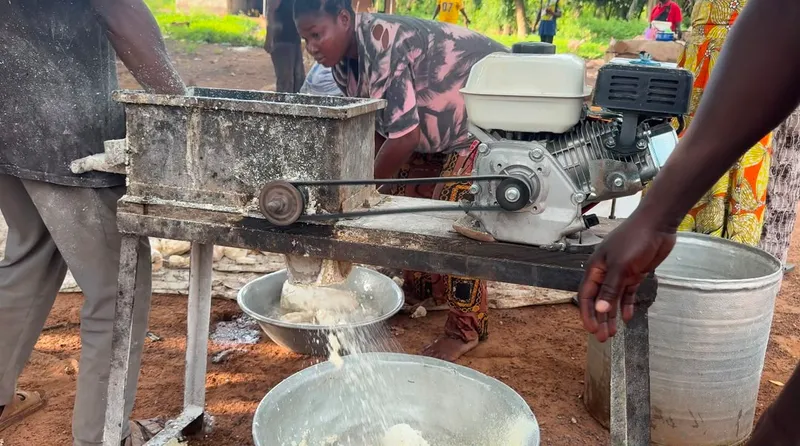
Before dawn breaks over Balai, women like Clara Kinyinkyde are already at work, peeling, washing, grating, pressing, and frying cassava by hand. Their fingers stained pale brown from cassava sap, their eyes stinging from smoke, they keep up a rhythm that has barely changed for generations. Nearby, a modern cassava-processing factory built to ease their labour sits silent, its machines still and gates locked.
The factory in Kpandai was commissioned on December 22 under the Rural Enterprise Programme (REP), part of the Ministry of Trade and Industry’s One District, One Factory initiative. It promised to transform cassava processing in the area by reducing physical strain, creating jobs, and improving incomes. For a few weeks, it seemed that hope might become reality.
Clara, 29, remembers those weeks well. “We worked for some weeks, but payment became a problem,” she said. “We were told to go home and that they would contact us. But they have not contacted us, so we returned to our old way of producing gari.”
The factory’s closure came without explanation or timeline. The women were simply sent home. Now, they return to the slow, exhausting manual process. For processors in Balai and surrounding villages like Enk, Kanchina, Lunto, Loduto, Kabauli, Kitari, Chakori, and Jambuay, gari processing is not just work — it’s survival.
Madam Mary, another processor, described the return to manual work as a setback. “We thought the factory would make our work easier and help us earn more money,” she said. “But because it has closed down, we have gone back to the old way of processing gari.”
The manual method demands hours of labour, from peeling to frying, all done by hand. It limits production and leaves little room for rest. When cassava spoils before processing, farmers and processors lose income. The factory was meant to break this cycle.
The Assemblyman for the area said the factory was designed to ease women’s burden and shift gari processing to semi-industrial levels. But electricity and equipment problems have kept it idle.
“Unfortunately, they could not fix that one,” he said. “I think it is the reason they have to use the plant to support it. And so, that is basically the challenge.”
District Chief Executive Haruna Abdul-Karim admitted the factory is not fully operational despite its commissioning. “We have what we call the commissioning of something, and we also have a question to ourselves: what we have commissioned, is it commissioned to be used for the purpose for which it was built?” he said.
According to Abdul-Karim, the facility needs a dedicated transformer and other machinery before it can function. The Assembly is working with the Volta River Authority and other stakeholders to fix the power supply issues.
For the women, the technical details offer little comfort. They want the machines running. An operational factory would mean shorter processing times, higher output, and relief from the physical toll of working beside smoky fires. It could also free time for their children to go to school instead of watching their mothers labour.
“We are only asking them to fix the factory and allow us to work,” Madam Mary said.
As evening falls, the women pack their gari into sacks and carry it home. Their bodies ache, their clothes smell of smoke, but their determination remains. The factory stands quiet, a reminder of a promise that has yet to be fulfilled. In Kpandai, the women wait not for more promises, but for the machines to start moving again.
According to 3News.