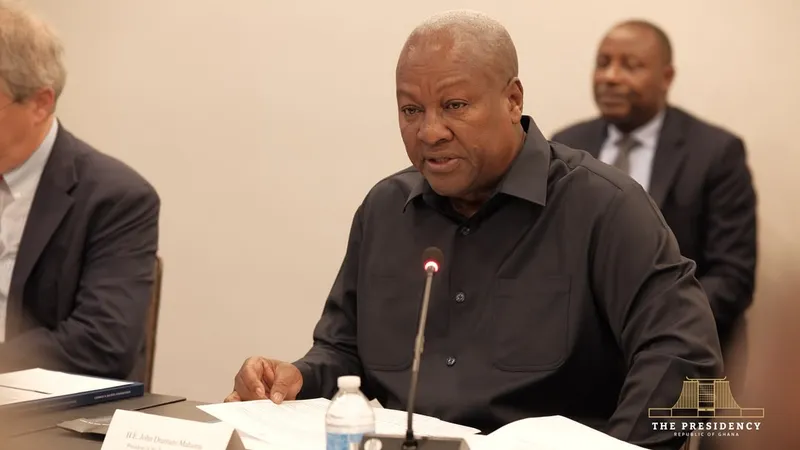
A coalition of eleven civil society organisations has called on President John Dramani Mahama to stop offshore gold exploration near Ghana’s inshore waters, citing legal and environmental concerns. In an open letter dated 28 September 2026, the groups urged an urgent review of GoldCoast Resource Corp.’s offshore reconnaissance activities along Ghana’s western continental shelf.
GoldCoast Resource Corp. holds ten offshore reconnaissance licences covering about 10,000 square kilometres. These extend roughly 300 kilometres along the coast between Half Assini and Winneba, reaching about 33 kilometres offshore. The CSOs point out that significant portions of this area fall within Ghana’s Inshore Exclusion Zone (IEZ), defined by the Fisheries and Aquaculture Act, 2025 (Act 1146) as the coastal waters up to twelve nautical miles, or about 22 kilometres, from the shoreline.
The organisations say the exact overlap between the licences and the IEZ remains unclear because the government has not published the official cadastral coordinates or licence documents. The letter warns this lack of transparency makes it difficult to assess whether the activities comply with existing laws designed to protect fisheries, biodiversity, and coastal livelihoods.
The CSOs highlighted that GoldCoast has already collected around 50,000 line-kilometres of airborne magnetic data across the entire licensed area. More detailed surveys are focused on a 500 square kilometre priority zone near the mouth of the Ankobra River. The letter says the company’s plans include marine bathymetric and seismic surveys, followed by vibro-core drilling and bulk seabed sampling. However, no mineral resource or economic viability has yet been established.
The coalition raised serious legal questions about these planned activities. They cite Section 32(3) of the Minerals and Mining Act, 2006 (Act 703), which forbids reconnaissance licence holders from drilling or excavating. The CSOs argue that vibro-coring and bulk sampling, which involve seabed excavation and dredging, cannot be considered reconnaissance.
They also point to section 99(6) of the same Act, which makes it an offence to use floating platforms or equipment for mining or dredging in Ghana’s natural water bodies, including the territorial sea, exclusive economic zone, and continental shelf. The letter asks how drilling, bulk sampling, dredging, or eventual extraction could proceed legally given these provisions.
The group emphasised that Ghana is currently working to rebuild depleted fish populations, protect marine habitats, and strengthen safeguards for small-scale fisheries. They cited the Marine Fisheries Management Plan 2022–2026, which estimates the fisheries subsector employs about 10% of Ghana’s population—more than three million people—in roles ranging from fishers to processors and boat owners.
Data from the 2022 Canoe Frame Survey counted 110,351 marine artisanal fishers and 12,181 canoes, while the Fisheries Commission’s 2025 Annual Performance Report recorded 282,658.29 metric tonnes of artisanal fish landings, representing 63.68% of total landings. The CSOs warn that the planned offshore activities could disrupt spawning and nursery grounds, benthic habitats, and marine mammals.
They referenced international cases from Norton Sound, Alaska, and Bangka-Belitung in Indonesia, where offshore mining reduced benthic abundance and damaged seagrass habitats. The coalition described the issue as also raising constitutional and human rights concerns, citing Articles 21(1)(f), 23, 35(6)(d), 24, 36, 37, and 257(6) of the 1992 Constitution, as well as Ghana’s obligations under the International Covenant on Economic, Social and Cultural Rights and the African Charter on Human and Peoples’ Rights.
The CSOs asked the government to publish official coordinates, licence instruments, conditions, and approved work programmes for all ten offshore licences. They want an independent spatial overlay showing the licences against the 12-nautical-mile IEZ, the Greater Cape Three Points Marine Protected Area, key fishing grounds, and sensitive habitats.
They also called for clear legal and environmental approval processes for each phase of exploration, especially vibro-core drilling, bulk sampling, and dredging. The groups urged that no prospecting licence be granted or intrusive seabed activity allowed without thorough environmental, fisheries, socio-economic, and human rights assessments, alongside meaningful stakeholder participation.
Finally, the CSOs want a transparent review to decide whether the licences should remain unchanged, be modified to exclude sensitive areas, or be cancelled if legal grounds exist.
“Ghana has taken important steps to expand the IEZ, rebuild its fisheries and establish its first Marine Protected Area. The same shallow coastal waters should not be subjected to a potentially competing extractive use without first establishing, transparently and scientifically, the consequences for fisheries, biodiversity and the coastal communities that already depend on them,” the letter states.
The petition was signed by Environmental Justice Foundation (EJF), Centre for Maritime Law and Security Africa (CEMLAWS Africa), Global Fisheries and Resilience Action, Hen Mpoano, OCEANA, Friends of the Nation, Development Action Association, CEWEFIA, CERATH Development Organisation, A Rocha Ghana, and Oxfam. Copies were sent to the Vice President, Chief of Staff, and Council of State.
According to 3News.