

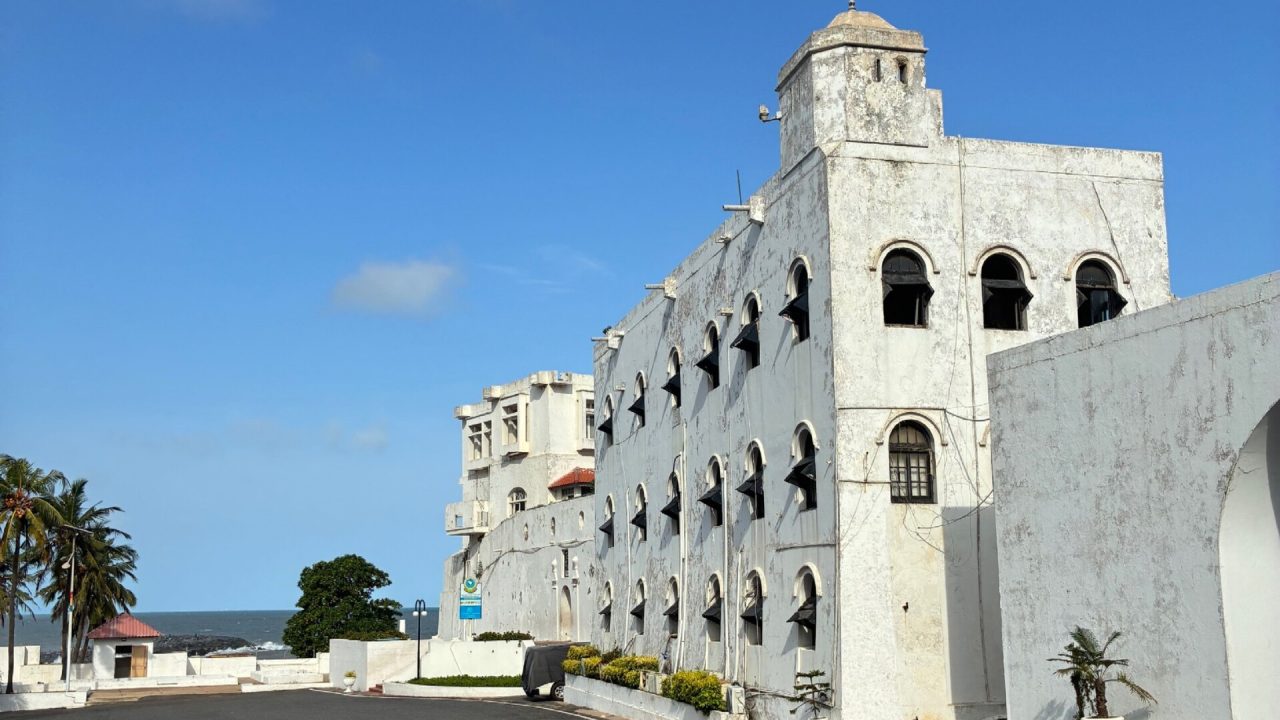
In 1661, a Danish governor named Jost Cramer paid 3,200 gold florins to the Ga chief Okaikoi for a piece of land on the Osu shore.
The fort the Danes built there was called Christiansborg, “Christian’s fortress”, after the King of Denmark. Ghanaians know it as Osu Castle, and for most of the next 350 years, whoever held that building held power over the Gold Coast and, later, Ghana.
A fort that kept changing hands
The Danes were not the only Europeans on this stretch of coast. The Dutch had Ussher Fort and the British had James Fort, both a few kilometres west in what is now central Accra. Christiansborg itself changed hands several times through capture and sale in its early years, including a period when it was seized by Akwamu forces, before the Danes regained control.
Like the other coastal forts, Christiansborg was tied to the Atlantic slave trade. Enslaved Africans were held in its dungeons before being shipped across the ocean. Denmark sold its Gold Coast possessions, Christiansborg included, to Britain in 1850.
The seat of government
In 1902 the castle became the seat of the British colonial government and the residence of the governors. After independence in 1957 it stayed at the centre of power. Ghana’s heads of state, civilian and military, governed from the castle for most of the following decades. The phrase “the Castle” became shorthand in Ghanaian politics for the presidency itself.
The move away came in stages. Jubilee House, the new presidential palace near the Ridge, was built during John Agyekum Kufuor’s second term. John Evans Atta Mills preferred to stay at the castle after taking office in 2009. In 2013, under John Dramani Mahama, the seat of government moved to Jubilee House for good.
From power to museum
In 2017, as part of Ghana’s 60th independence anniversary projects, the castle was turned into a presidential museum. It is still a protected state property, and access depends on permission, which has kept it less visited than the Cape Coast and Elmina castles in the Central Region.
Osu around it
The neighbourhood that grew up around the castle took its name, and Osu is now one of the busiest parts of the city, known for Oxford Street’s restaurants, bars and shops. Most people eating on Oxford Street at night are less than two kilometres from the castle walls, and many have never been inside.
The Ga chief who sold the land in 1661 was paid in florins. The building he sold it for went on to house almost every ruler Ghana had for more than a century.
_in_Accra,_Ghana.jpg)