At midnight between 5 and 6 March 1957, Kwame Nkrumah stood before a crowd on the Old Polo Grounds in Accra and told them Ghana was free, forever.
Thirty-five years later, on 1 July 1992, the same ground became his resting place. The Kwame Nkrumah Memorial Park, opened under Jerry John Rawlings, holds the mausoleum where Nkrumah is buried, and it is one of the most visited historical sites in the capital.
A colonial playground
The Old Polo Grounds had been a British colonial leisure ground, used by officials for polo and other sport. That was part of the power of the location. The independence ceremony inside the Old Parliament House was formal, attended by representatives of the Queen and the colonial government. The Polo Grounds were where the public gathered in huge numbers, on land the colonial class had used for its games.
Nkrumah’s speech that night, “at long last, the battle has ended”, and his line that Ghana’s independence was meaningless unless it was linked to the total liberation of Africa, are among the most quoted words in the country’s history.
Exile, death and three burials
Nkrumah was overthrown in a coup on 24 February 1966 while he was abroad. He spent his last years in Conakry, Guinea, and died of cancer in Bucharest, Romania, on 27 April 1972.
His body was first buried in Guinea. It was later returned to Ghana and buried in his home town, Nkroful, in the Western Region. The final move came in 1992, when his remains were brought to the new mausoleum in Accra. His wife, Fathia Nkrumah, who died in 2007, was later buried beside him.
What visitors see
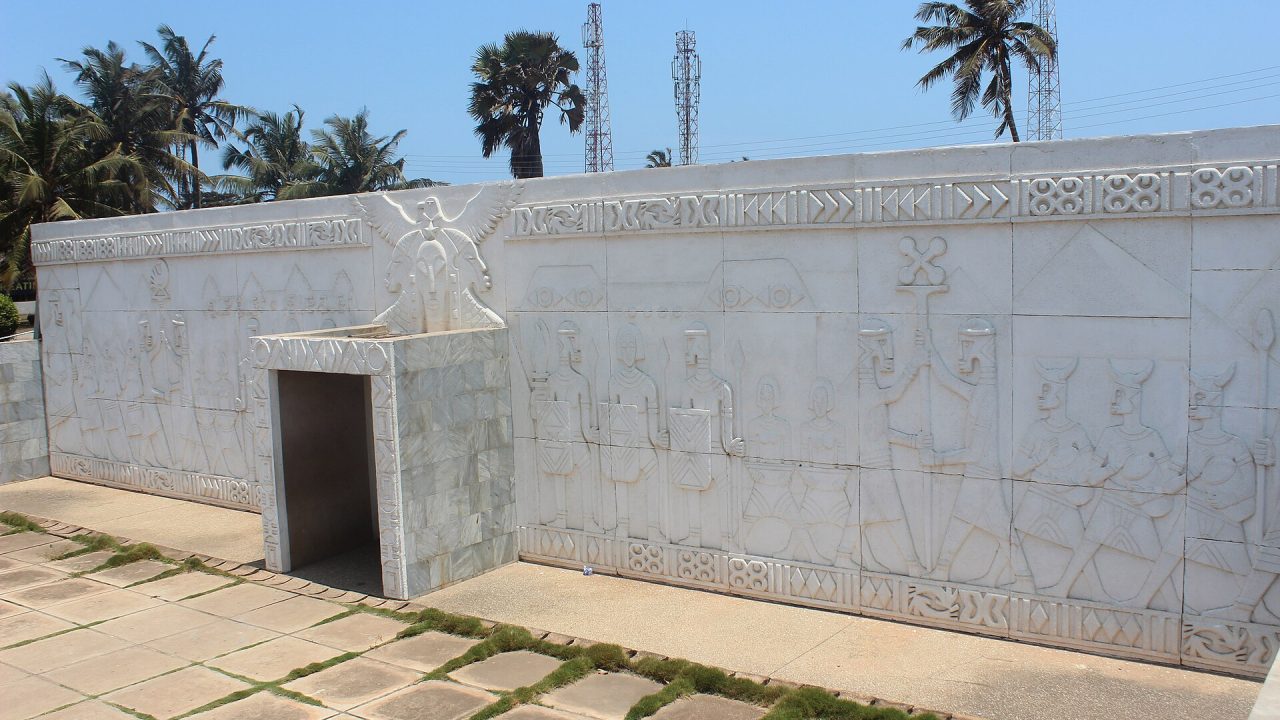
The mausoleum is built to resemble an upturned sword, a symbol of peace in Akan tradition, and is clad in marble. It stands in a pool of water surrounded by fountains and statues of flute players. A bronze statue of Nkrumah stands in the park, and a museum holds his personal belongings, photographs and books.
The park was renovated and reopened in 2022 after work that expanded the grounds and the museum, and it now draws school groups, diaspora visitors and tourists in steady numbers throughout the year.
The ground and the man
Ghana has argued about Nkrumah for more than half a century: the founding hero, the leader who jailed opponents under the Preventive Detention Act, the pan-Africanist whose projects outlived him. Even his birthday has been fought over. A 2019 law moved Founders’ Day to 4 August and reduced 21 September to Kwame Nkrumah Memorial Day; a 2025 amendment under President Mahama restored 21 September as Founder’s Day.
The crowd that waited on the Polo Grounds in 1957 came to hear him speak. Visitors to the same spot now come to see where he is buried.