The government is investing in new science, technology, engineering and mathematics facilities at Bandaman Senior High Technical School in Banda District, aiming to shift the local economy from agriculture to technical skills. Ahmed Ibrahim, Minister of Works, Housing and Water Resources and Member of Parliament for Banda, said the expansion will prepare young people to take advantage of opportunities created by major projects in the area, including the Bui Hydro Dam.
Speaking during an inspection of ongoing projects funded by the Ghana Education Trust Fund (GETFund), Ibrahim said the district must move beyond farming. “We are in the era of knowledge capital, where the human resources of the place, of the people, are the greatest asset that we have,” he said.
About 44,000 acres of land in Banda have been acquired for the Bui Hydro Dam project, affecting communities dependent on farming. Despite the dam employing around 644 workers, Ibrahim noted that few are from the district. “Clearly, if care is not taken to train the people scientifically, in the near future the sustainability of the project will not be guaranteed,” he added.
This concern drives the government’s focus on STEM education in Banda. Ibrahim said the upgraded school would produce professionals such as electrical and mechanical engineers, doctors and accountants capable of securing jobs in local and regional institutions. “Now that government is building a modern STEM science laboratory for us, we have no excuse. We just have to strengthen the basic education to make sure that we produce teachable children for the secondary school,” he said.
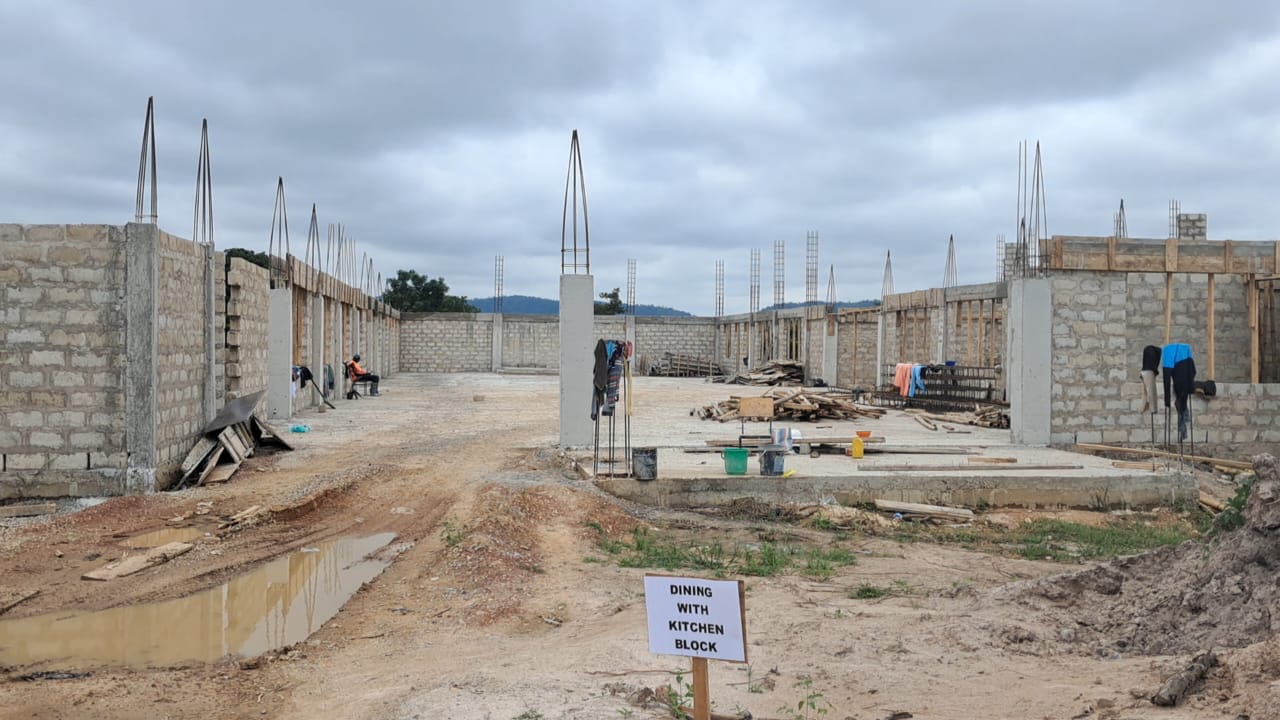
Bandaman Senior High Technical School opened in 2010 and currently has 687 students. Its infrastructure has not kept pace, with an abandoned E-Block and overcrowded facilities. Headmaster Ebenezer Kofi Latah described the challenges: “The dining hall is just a small space, and now, looking at our population, sometimes during break time, we need to break them into two or three batches, and that is affecting instructional time.” He added that the girls’ dormitory is also full.
Under GETFund’s New Targeted Emergency Projects, the school is receiving nine major infrastructure upgrades. These include a 2,000-capacity dining hall and kitchen, two two-storey dormitory blocks for boys and girls, seven two-unit semi-detached teachers’ bungalows, a three-bedroom headmaster’s bungalow, an 18-unit three-storey classroom block, a two-storey science laboratory, and a two-storey administration and library block.
The projects also cover science laboratory equipment, boreholes, and external works such as a gatehouse. Simon Mawuli Sabakpo, Zonal Consultant of AESL for the Bono, Ahafo and Bono East regions, said the developments are at various stages. Some teachers’ bungalows could be completed and handed over within a month, while contractors are working to finish the other facilities ahead of schedule.
The headmaster said the new infrastructure will improve teaching and learning and allow the school to admit more students. “With the science laboratory, I’m told that it’s going to be equipped and fully furnished. So the massive infrastructure development here is going to be a relief to our school,” Latah said. “We really pray that the project will be completed on time, so that the school can admit more, and then it will facilitate teaching and learning.”
Nana Peh Aboatea II, Acting President of the Banda Traditional Council, called on natives of Banda both within and outside the district to support efforts to improve local educational infrastructure. The new facilities may change the district’s professional landscape, but the community’s involvement remains essential.
According to Joy Online.