
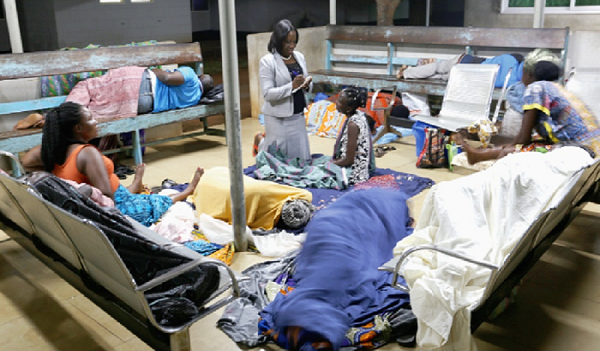
Ghana has launched a pilot emergency bed management system with a command centre at Ridge Hospital to address the country’s persistent “no bed syndrome” in hospitals. The system gives officials real-time data on available and occupied beds in emergency wards.
Health Minister Kwabena Mintah Akandoh disclosed the initiative during an interview on Joy News’ PM Express on Wednesday. He said the command centre at Ridge Hospital coordinates the system, allowing him to monitor emergency bed availability remotely.
“I have a screen in my office, so that if Korle-bu says there’s no bed, I’m able to see how many beds are available, how many patients are in the emergency,” Akandoh said.
The pilot covers selected regional and teaching hospitals. It tracks how long patients remain in emergency wards, enabling officials to question cases where patients stay longer than 24 hours despite reports of bed shortages.
“If you’ve been there for more than 24 hours, and they see you are still there, and they say there is no bed. I will be able to ask questions because there’s a whole command centre in charge of that,” he added.
The system does not increase the total number of beds but aims to improve management of existing resources. “So this system will not necessarily add more beds, but it will help us to manage the scarce resources, so that one patient will not be on one bed at emergency for more hours or another,” Akandoh said.
Alongside the system, the government is expanding emergency capacity at major hospitals including Korle-Bu, Komfo Anokye, Tamale, and 37 Military Hospital. Korle-Bu’s emergency unit currently has about 67 beds out of more than 1,000 total beds. A new 400-bed facility is under construction there as part of a wider redevelopment project.
“The contractor is on site as I speak to you now. So we call it a hospital within a hospital,” the minister said.
Beds in participating hospitals have been barcoded, and designated commanders at each facility are responsible for updating the system continuously.
“Yes, the beds have barcodes, and there are commanders at each facility to be putting the data in at every moment,” Akandoh confirmed.
The ambulance service has also been integrated into the system to guide patient destination decisions. The government currently operates more than 200 ambulances, which were insured in 2025. Plans are underway to add 100 new ambulances in 2027.
“We are going to add 100 brand-new vehicles,” Akandoh said.
The pilot system aims to bring transparency to how emergency beds are used and to prompt questions about prolonged patient stays. It is part of a broader effort to manage hospital resources more efficiently amid ongoing capacity challenges.
According to Joy Online.