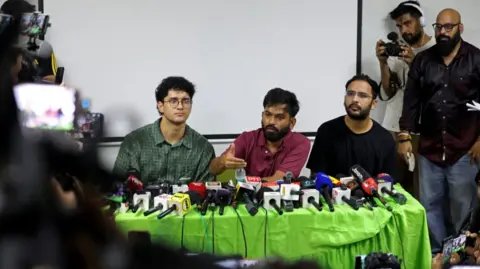
Thousands of protesters known as the Cockroach Janta Party plan to return to Delhi’s streets on Friday despite recent arrests and police efforts to prevent their demonstrations. The youth-led movement, which demands electoral reforms, called supporters to gather at Central Park in Connaught Place, a busy commercial district not authorised for protests.
The move follows the jailing of two CJP leaders, Saurav Das and Ashutosh Ranka, for five days after they entered Jantar Mantar, a site recently declared off-limits by police. Both men were detained for breaching restrictions and violating the terms of their earlier release. Another organiser, Ajinkya Shinde, was released on bond conditioned on maintaining peace.
The CJP founder, Abhijeet Dipke, named the upcoming protest Lehra Do Tiranga, or Wave the Tricolour, referring to India’s orange-white-green flag. Dipke said he is prepared to risk arrest himself and urged supporters unable to reach Delhi to protest locally by raising the Indian flag.
Getting to Central Park may not be straightforward. Police used barricades and mass detentions to block many protesters from joining their last mass demonstration on Saturday. Dipke, Das, and Ranka were detained while still on their aircraft upon arriving in Delhi. The capital was placed under a heavy security lockdown, with tens of thousands of police and paramilitary personnel sealing roads, shutting metro stations, and intercepting protesters before they could assemble.
The crackdown drew accusations that authorities aimed to prevent the protest rather than merely police it. The CJP compared the police action to India’s Emergency period between 1975 and 1977, when civil liberties were suspended. Footage captured by the BBC showed dozens of people—including journalists and students—being detained. Some protesters struggled as police dragged them into buses, while others pressed against bus windows waving Indian flags. The BBC also recorded a policeman slapping a detained protester inside a bus. The Delhi police did not respond to questions about alleged violence.
The CJP began in May after India’s chief justice likened some unemployed youth to cockroaches. Dipke embraced the insult, turning it into an online protest movement. By July, the group was mobilising over examination paper leaks, forcing education minister Dharmendra Pradhan to resign. The movement has since grown into one of the loudest youth voices against Prime Minister Narendra Modi’s government, focusing now on electoral roll revisions.
The protests target the Special Intensive Revision, a sweeping electoral roll update that critics say has removed over 130 million names, risking disenfranchisement of legitimate voters. The CJP demands the resignation of Chief Election Commissioner Gyanesh Kumar, accusing the commission of favouring Modi’s Bharatiya Janata Party—a claim denied by both the commission and government.
The Delhi High Court rejected a petition by a local trader seeking to restrain Friday’s protest, citing disruptions to traffic and business. Police have told demonstrators to use approved sites such as Ramlila Maidan, Burari Ground, or CBD Ground instead of Jantar Mantar, an 18th-century observatory near parliament long known as a protest venue. The CJP argues that pushing protests away from Jantar Mantar reduces their visibility and impact.
On Tuesday, Das and Ranka returned to Jantar Mantar with a small group, unfurling the Indian flag and chanting slogans against Kumar. Police said some protesters climbed over a locked gate to enter, violating their release conditions. They were arrested and sent to Tihar Jail.
With two leaders in custody, the CJP’s leadership is depleted but determined. Dipke said in a video, “I also may be jailed after this, but I am not worried. Tricolour is my pride and I will raise it.”
Senior police officers met Thursday to plan security around Connaught Place, anticipating disruptions in one of Delhi’s busiest commercial hubs. The authorities are preparing for another large gathering amid ongoing tensions over protest rights and electoral integrity.
According to Joy Online.