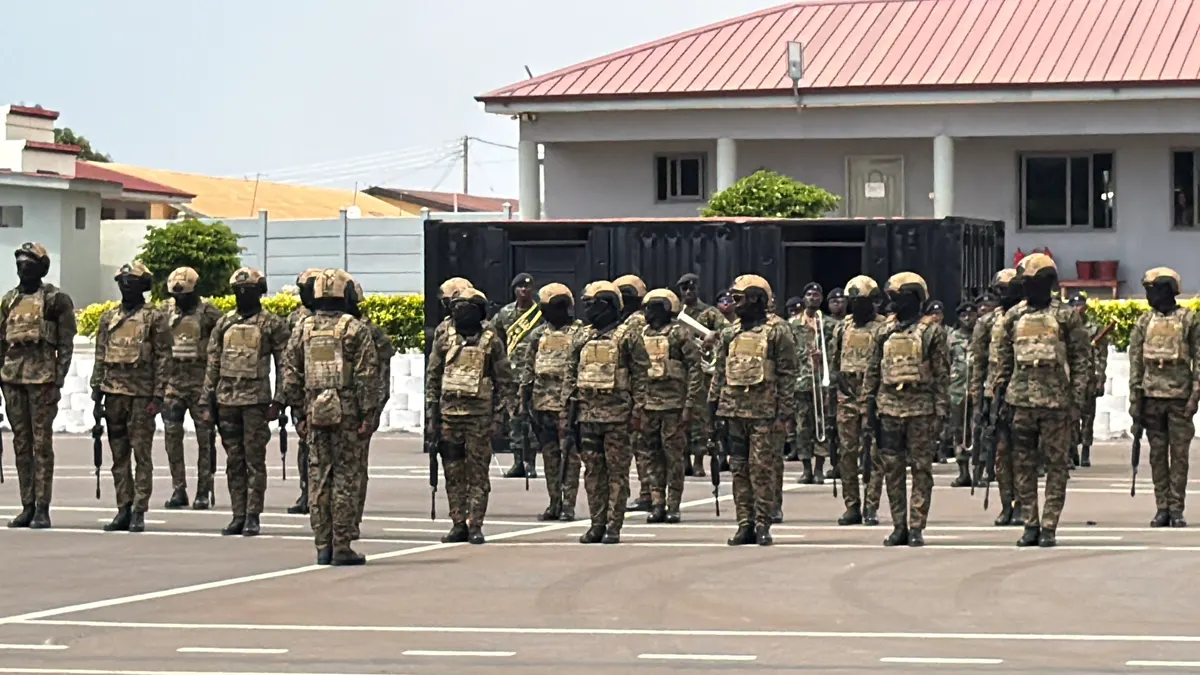
Twenty Ghana Armed Forces personnel have completed a nine-month Army Special Operations Forces Basic Course that began in January 2026, following a demanding selection process that started with 87 candidates in November 2025. Only 30 qualified to start the course, and after intensive training and practical exercises, 20 successfully graduated.
The graduates include one officer and 19 soldiers. Thirteen come from the Army Special Operations Brigade, while the other seven are drawn from various units and training institutions within the Ghana Armed Forces. The course aimed to develop physical endurance, mental resilience, tactical skills, and leadership necessary for operations in complex environments.
Over the nine months, the trainees were exposed to a variety of operational settings, including urban, rural, jungle, riverine, and mountainous terrain. Their instruction covered navigation, fieldcraft, communications, weapons handling, mission planning, leadership, special reconnaissance, counter-terrorism, counter-insurgency, and close-quarter battle.
Brigadier General Richard Mensah, Commander of the Army Special Operations Brigade, said the training was particularly important given the evolving security challenges in West Africa and the Sahel, where terrorism, violent extremism, and organized crime continue to pose threats. He described the Special Operations Forces as having a distinct function in supporting broader military efforts through specialized skills and flexibility.
Brigadier General Mensah urged the graduates to maintain the warrior ethos of the brigade and uphold professionalism and discipline. He called on them to continue improving their physical fitness, tactical skills, and leadership beyond the course. The graduates are expected to apply what they learned to their assignments while adhering to teamwork and operational excellence.
The Ghana Armed Forces see the specialised training as a way to build a force capable of responding to emerging threats and protecting the country’s territorial integrity. The focus on discipline, adaptability, and decision-making reflects the unpredictable nature of the environments in which the personnel may be deployed.
The course began with a rigorous selection phase in November 2025, where 87 personnel were assessed. Only 30 passed and entered the training on January 12, 2026. The reduction to 20 graduates after nine months demonstrates the demanding nature of the course.
The training’s emphasis on leadership skills, alongside physical and tactical abilities, indicates the role these personnel will play in future military operations requiring advanced capabilities. The army’s investment in such specialised instruction reflects growing concerns about security risks in the sub-region.
Brigadier General Mensah’s comments linked the training directly with the need to address terrorism, extremism, and crime in West Africa. The graduates’ ability to operate across varied terrains and conditions is a response to the unpredictable and complex threats faced by the Ghana Armed Forces.
The completion of this course adds to the capabilities of the Army Special Operations Brigade and the wider Ghana Armed Forces. It also points to the continuing evolution of military training to meet new challenges in regional security.
The graduates will now join their units, prepared for assignments that demand advanced operational skills. Their progress reflects the Ghana Armed Forces’ ongoing efforts to adapt and strengthen their response to security threats in West Africa.
According to 3News.