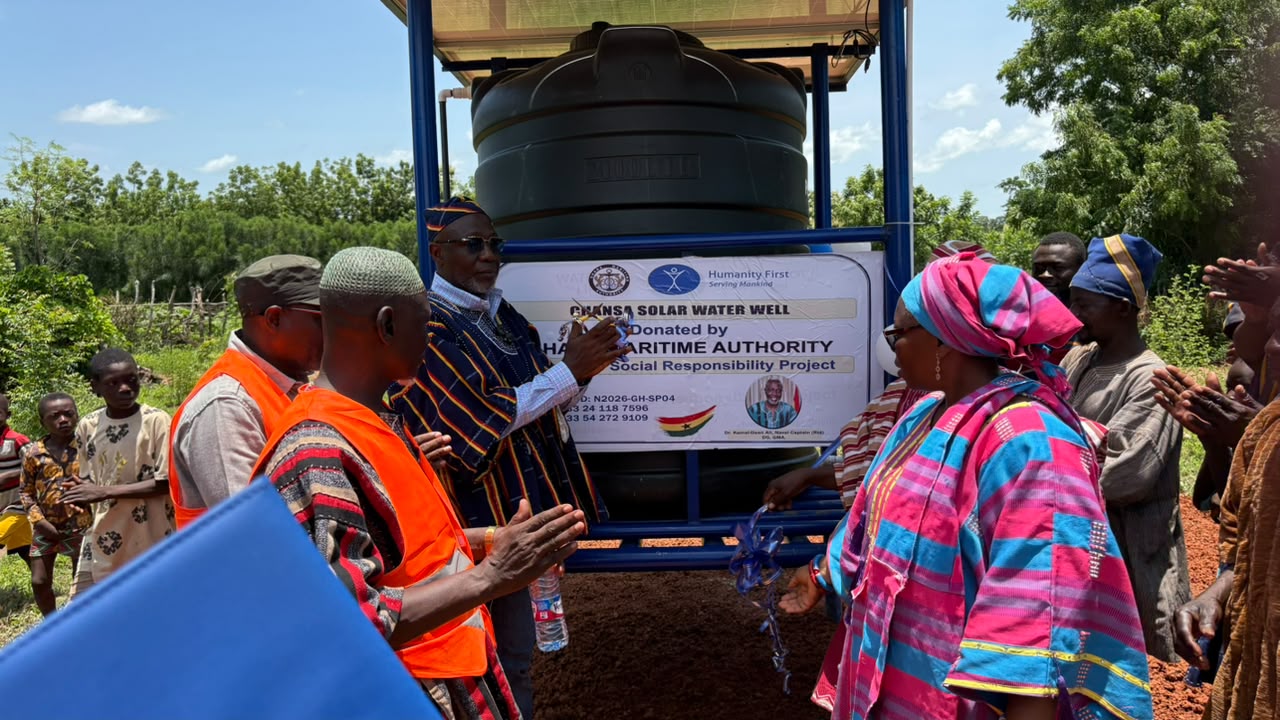
The Ghana Maritime Authority and international humanitarian organization Humanity First Ghana have handed over four newly constructed solar-powered mechanized boreholes to beneficiary institutions and communities in the Wa Municipality. The facilities, sited at T.I. Ahmadiyya Senior High School, Chansa, Biihee, and Boli, will provide clean, potable water to underserved communities in the Upper West Region.
Wa Residents Get Relief from Water Scarcity
The four boreholes are part of a broader seven-borehole Corporate Social Responsibility (CSR) initiative designed to eliminate severe water distress, improve public sanitation, and protect basic instructional hours across the region. Director General of the Ghana Maritime Authority, Naval Captain (Rtd) Dr. Kamal-Deen Ali, explained that the intervention aligns directly with national development priorities.
Speaking at the commissioning ceremonies, Dr. Kamal-Deen Ali stated, "Water is very key to life. Without water, there is no education, no survival, and health problems multiply." He added that the boreholes will enhance students' studies, keep them in school, and provide unhindered access to the surrounding communities.
Chronic Disruptions to Academic Calendars a Thing of the Past
Beneficiary schools had previously endured chronic disruptions to their academic calendars due to the scarcity of water. At T.I. Ahmadiyya Senior High School, Headmaster Issahaque Yahaya recounted how the absence of reliable water exacerbated sanitation pressures for the school's 1,433 students. Student leaders noted that the scarcity had severe health and academic repercussions.
Senior Prefect Kunkuni Masroor shared, "Before this borehole was mechanized for us, almost all the sicknesses recorded from the school at the hospital were typhoid. Now, we have clean water powered by solar, which runs even during power outages and helps us get to class on time." Girls' Prefect Mac Adams Qaaimah added that the daily struggle for water often forced students to miss morning hygiene routines.
Local Communities Celebrate Removal of Commercial Water Charges
Residents in the rural communities of Biihee and Chansa celebrated the removal of commercial water charges. At first, the whole community depended on one hand pump. If you went in the morning, you wouldn't return until 5:00 PM, noted Biihee resident and teacher, Yahaya Niamatu. Other facilities operated on a cash-and-carry basis where you had to pay before fetching, which many families could not afford.
Regional Coordinator for Humanity First Ghana, Maulvi Abu Zul-Haq, detailed the technical setup, noting that the systems operate on solar power with national grid backups, pumping water into elevated storage tanks with detached discharge points to prevent structural wear. He urged local school administrators, Assembly Members, and residents to establish strict community monitoring to protect the solar infrastructure from theft or damage.
Next Steps in the Initiative
The intervention brings immediate relief to beneficiary schools that previously endured chronic disruptions to their academic calendars. Following the handovers in Wa Municipality, additional mechanized water systems will be installed at Jirapa and Nandom in the coming weeks, and a consignment of 400 sets of dual desks and tables will be delivered. The initiative is a testament to the collaboration between the Ghana Maritime Authority and Humanity First Ghana in addressing the water scarcity challenges in the Upper West Region.
Source: Joy Online