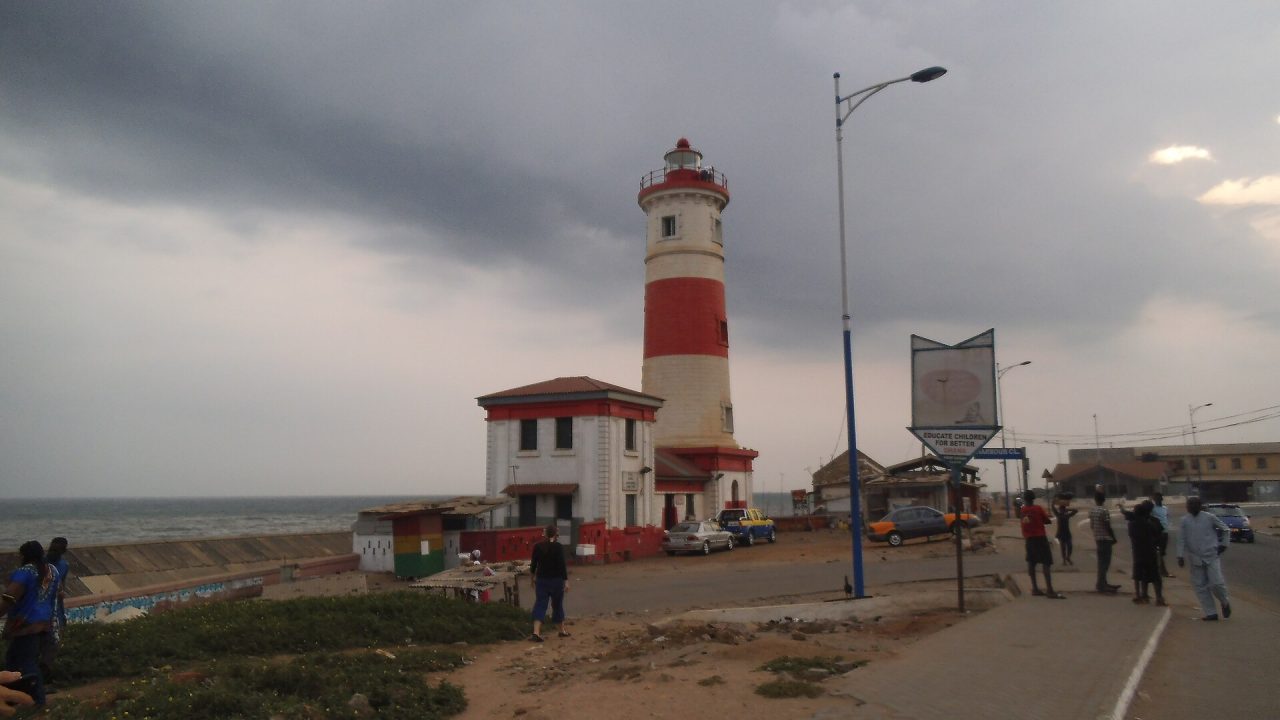
The red-and-white tower that rises over Jamestown’s fishing harbour is the second lighthouse to stand on that spot. The first went up in 1871.
As shipping along the Gold Coast grew in the early twentieth century, the colonial authorities replaced the original with a taller, more modern structure. The current Jamestown Lighthouse was completed in 1932. It stands about 28 metres high, with a light about 35 metres above sea level, and its striped tower is one of the most photographed landmarks in Accra.
Guiding ships
Before modern navigation systems, lighthouses were vital on the West African coast, where ships approached a shoreline with few natural harbours and dangerous surf. The Jamestown light helped vessels find Accra’s roadstead, where ships anchored offshore and passengers and cargo were brought to land by surf boats rowed by local boatmen.
Jamestown around it
The lighthouse overlooks Jamestown, one of the oldest parts of Accra. The district grew around James Fort, built by the British in the seventeenth century, and the area is home to Ga fishing families, boxing gyms, traders and old colonial buildings. The fishing harbour below the lighthouse is busy from early morning, when canoes return with their catch and women buy fish to smoke and sell.
Visiting
Visitors can climb the lighthouse for a fee paid to the caretakers. The narrow stairs lead to a gallery near the top with views over the harbour, the Atlantic, the old forts and the Accra skyline. Guides from the community often offer walking tours of Jamestown that include the lighthouse, James Fort, Ussher Fort and street art from the Chale Wote festival.
Visitors should go with a local guide, agree on fees in advance and ask before photographing people in the fishing community.
A symbol of Accra
The lighthouse appears in films, music videos, fashion shoots and wedding photographs. Its colours and shape make it instantly recognisable, and it has become a symbol of old Accra in contrast to the glass towers of the newer business districts.
Challenges
Like much of Jamestown, the area around the lighthouse faces pressures: coastal erosion, pollution, poverty and questions about how redevelopment will affect long-time residents. The Jamestown fishing harbour has been the focus of a government redevelopment project, and residents have followed the plans closely.
The forts nearby
The lighthouse is part of a cluster of historic buildings. James Fort, beside it, was built by the British in the seventeenth century and later used as a prison. A short walk east, Ussher Fort began as the Dutch Fort Crèvecoeur in the mid-1600s and was renamed after the British took it over in 1868. Both forts were part of the coastal trade that included the trade in enslaved Africans, and both are now heritage sites that visitors can tour alongside the lighthouse.
The light was built to guide ships. It now guides tourists, photographers and returning Accra residents to the part of the city where it all started.