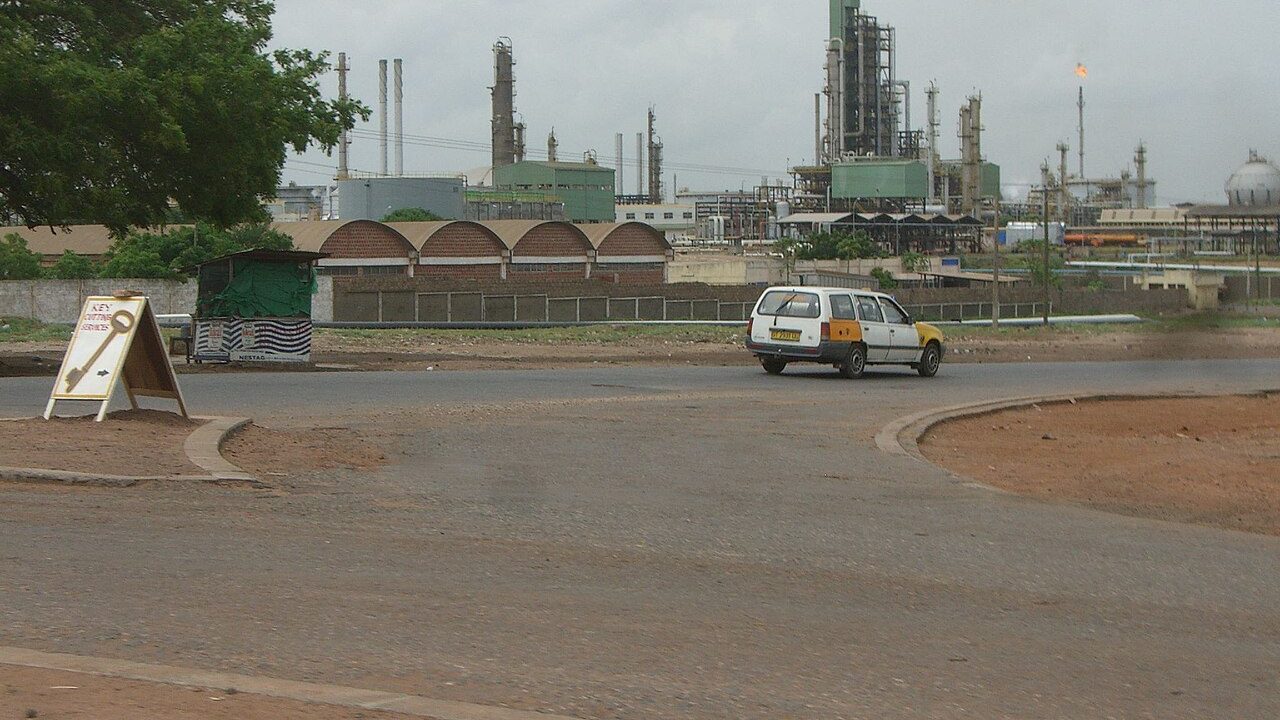
On the industrial edge of Tema stands a cluster of tanks, towers and pipes that has been part of Ghana’s economy since the Nkrumah years. It is the Tema Oil Refinery, the country’s only petroleum refinery.
It was commissioned on 28 September 1963. For more than six decades, it has been praised as a national asset and criticised as a money pit.
An Italian partnership
The refinery began as the Ghanaian Italian Petroleum Company, known as GHAIP, a venture with the Italian state energy group ENI. It was one of the first major industrial investments after independence, alongside the Akosombo Dam and the port at Tema.
Kwame Nkrumah’s government saw it as part of a plan to industrialise Ghana and reduce dependence on imported finished goods.
What it does
TOR is a hydro-skimming refinery. It processes crude oil into liquefied petroleum gas, petrol, kerosene, diesel and fuel oil. Its capacity has been expanded over the years, including a unit to increase the production of petrol.
Full state ownership
In April 1977, the government bought all of ENI’s shares, making the refinery 100 percent state-owned. In 1991, it was renamed the Tema Oil Refinery Limited.
Troubles
The refinery has had long periods of low production or complete shutdown. Problems have included breakdowns, fires, lack of money to buy crude oil and heavy debts, including money owed by state agencies and fuel distributors.
When TOR is not running, Ghana imports almost all of its refined fuel, which exposes the country to world prices and exchange rates.
Oil at home
Since Ghana began producing its own crude oil in 2010, many have asked why the country still struggles to refine it. Governments have announced plans to revive TOR, bring in private partners or build new refineries.
Competition
The opening of the large Dangote refinery in Nigeria has changed the regional fuel market, adding pressure on TOR to become efficient and competitive.
Jobs and Tema
The refinery has been an important employer in Tema, and its workers’ union has often campaigned for investment and against privatisation.
What next
Each new government promises to fix TOR. The refinery has outlived many of those promises. Whether it becomes a working asset again or a monument to good intentions depends on decisions that have been postponed for decades.