

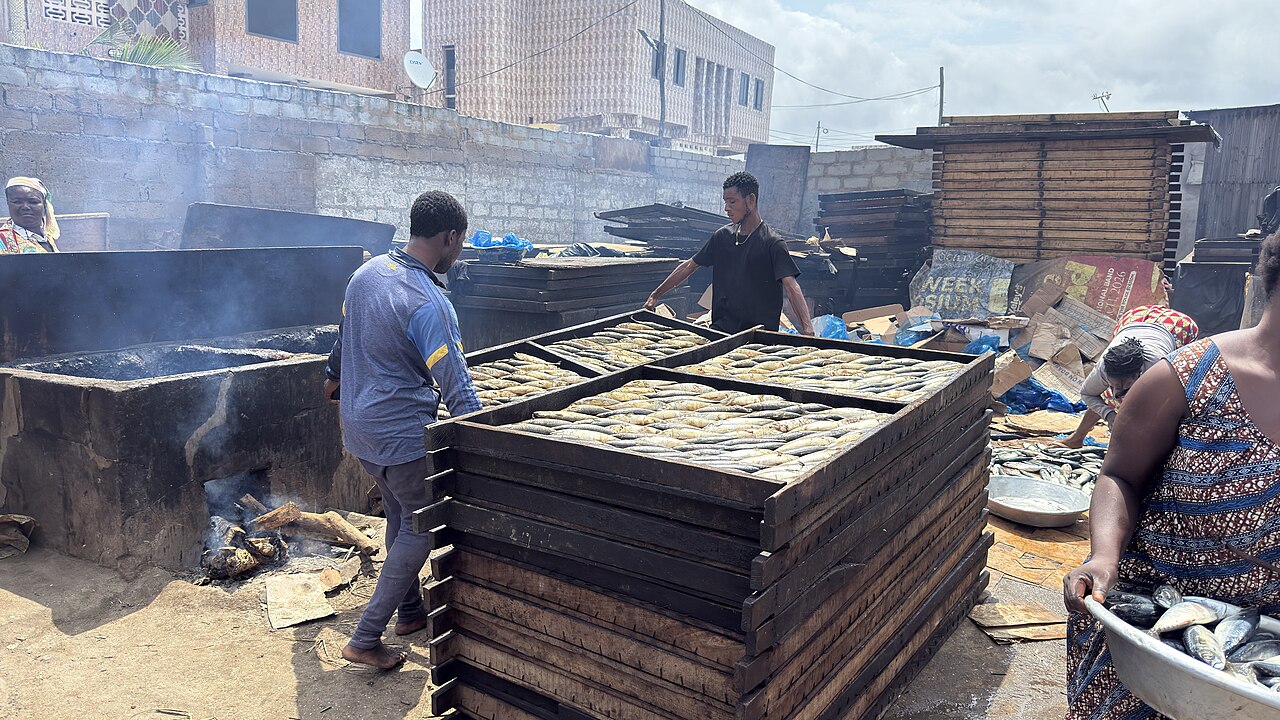
Walk through Chorkor, a fishing community on the coast west of Jamestown, and you see smoke rising from rows of ovens. Women stack trays of fish over wood fires to smoke herrings, mackerel and anchovies for sale.
Smoked fish is one of the main sources of protein in Ghana. It is eaten in soups and stews across the country, and it keeps well without refrigeration. The women who process it are central to the fishing economy, buying from the canoes, smoking the catch and selling it on to traders who carry it to markets inland.
The Chorkor smoker
Traditional smoking was done in round mud or metal ovens that used a lot of wood and produced uneven results. In the late 1960s and 1970s, the Food and Agriculture Organization of the United Nations and Ghanaian researchers worked with fish processors in Chorkor to develop an improved design.
The result, known as the Chorkor smoker, is a rectangular oven with stacked wooden-framed trays. It holds more fish, uses less fuel and smokes more evenly. The design was cheap to build and was adopted widely along the Ghanaian coast and in other West African countries.
The smoke problem
Over time, concerns grew about the smoke. The women who work over the ovens for hours are exposed to heavy smoke, which can damage the lungs and eyes. The smoking process can also leave harmful compounds, known as polycyclic aromatic hydrocarbons, on the fish at levels above international food safety limits.
The Ahotor oven
In the 2010s, researchers and development partners introduced the Ahotor oven, a design with a fat collector and a system to reduce smoke contact with the fish. Ahotor means “comfort” or “peace” in Fante. Trials showed lower levels of harmful compounds, less smoke and lower fuel use.
Adoption
Moving from the Chorkor smoker to cleaner ovens costs money, and processors need training and credit. Programmes have supported women’s groups to build new ovens, but many processors still use older designs.
Why it matters
Ghana’s fisheries face declining catches from overfishing and illegal fishing. Better processing reduces waste, improves health and can raise the value of smoked fish, including for export.
Chorkor gave its name to an oven used across West Africa. The next improvement will also be judged in its smoky yards, by the women who work there every day.



.jpg)